Solar Pool Heating in Florida: How It Compares to Other Types of Solar Heating
-
Share
Solar pool heating in Florida uses your existing pool pump to circulate water through roof-mounted collectors, where the sun warms it before it returns to the pool. It is an active, direct-circulation solar thermal system. It produces heat for your pool water and no electricity.
That sets it apart from several terms that show up in the same search results. Passive solar design, drain-back systems, glycol systems, and photovoltaic (PV) panels all use the sun, and each one describes different equipment built for a different job. Knowing which is which makes it easier to compare quotes and ask the right questions.
Advance Solar & Spa has installed solar pool heating across Southwest Florida since 1983, from Cape Coral and Fort Myers to Naples and Marco Island. This guide explains each type of solar heating, which one fits a Florida pool, and how a solar pool heater works alongside a heat pump.
Solar Heating Types at a Glance
| Type | What it heats | Uses a pump? | Freeze protection | Where you see it in Southwest Florida |
| Solar pool heating | Pool water | Yes, your existing pool pump | Collectors typically drain when the pump shuts off | Most residential pools |
| Passive solar | Living spaces, through building design | No | Not applicable | Home orientation, windows, and shading |
| Direct-loop (direct circulation) | The water you use | Yes | Must be designed for freezing weather | Pool heating and some household hot water |
| Drain-back | Usually household hot water | Yes | Fluid drains to a protected tank | Less common; needs specific plumbing pitch |
| Glycol (closed loop) | Household hot water, through a heat exchanger | Yes | Antifreeze fluid in the collector loop | Cold climates; rarely needed here |
| Solar electric (PV) | Nothing; it produces electricity | No fluid | Not applicable | Rooftop systems that power the home |
How Does Solar Pool Heating Work?
A solar pool heating system circulates pool water through roof-mounted collectors and returns it to the pool a few degrees warmer with each pass. The pool itself stores the heat, so the system needs no tank or heat exchanger.
- Your pool pump pulls water from the pool through the filter.
- A valve directs water to the solar collectors on your roof.
- The water rises through small tubes in each collector, absorbing the sun’s heat.
- The warmed water flows back down and returns to the pool.
- When the pump shuts off, the water typically drains from the collectors back to the pool.
Most pool solar panels in Southwest Florida are unglazed collectors, meaning they have no glass cover. That suits a pool, which needs a moderate temperature rise over a large volume of water. Homeowners often refer to this as a solar powered pool heater. The sun provides the heat directly, and the only electricity involved is for your pool pump.
Every system comes with a manual three-port valve to turn solar heating on or off. You can upgrade to an automatic controller that uses temperature sensors to switch the system on and off around your set temperature. Our systems can also connect to existing pool automation, such as Pentair IntelliTouch or Jandy AquaLink, so that you can control the solar like a thermostat from your phone or a wall panel.
Why Solar Pool Heating Fits Southwest Florida Pools
Florida pools need a moderate temperature boost for part of the year, and that is the job solar pool heating does best. A properly sized system can typically raise pool water about 10 to 15 degrees Fahrenheit above its natural temperature. Results depend on weather, collector size, pool size, wind exposure, and how the pool is used.
A solar pool heater in Florida does most of its work during the cooler, drier months from November through March, when sunny days still outnumber gray ones. It can extend a comfortable swim season well beyond what an unheated pool allows, and it reduces how much electricity or gas you use to heat the water. Once the system is installed, the sunshine itself costs nothing. The pool pump still uses electricity, as it does without solar.
Local homes suit the technology well. Collectors mount on shingle, tile, metal, and flat roofs, and on standing-seam metal roofs we use S-5! hardware that clamps to the seams without penetrating the roof. Screen enclosures have little effect on performance. A pool blanket is optional, and we recommend one with any pool heater because it cuts overnight heat loss through evaporation, so the water starts the day warmer.
Passive Solar Design Heats Buildings, and Solar Pool Heating Heats Water
Passive solar is a building design approach, and it does not heat a pool. It uses a home’s orientation, windows, construction materials, shading, and thermal mass to capture or block the sun’s heat. A south-facing window that warms a room in January is passive solar at work.
Passive designs have no pumps or collectors moving water. Solar pool heating is an active solar thermal system, because a pump circulates the pool water through the roof-mounted collectors.
What Is a Direct-Loop Solar System?
A direct-loop system, also called direct circulation, sends the water you plan to use straight through the solar collectors. Solar pool heating is the most common direct system in Florida. Pool water passes through the collectors, absorbs heat, and returns to the pool without a heat exchanger in between.
The main advantage is simplicity, since heat never has to pass from one fluid into another. Direct systems must be designed for the climate because a hard freeze can damage water-filled collectors and plumbing. A solar water heater for pool use in Southwest Florida still accounts for the occasional cold snap, which is why the collectors are designed to drain when the pump stops.
What Is a Drain-Down or Drain-Back Solar System?
A drain-back system lets water or heat-transfer fluid leave the collectors when the system is off, so nothing remains in exposed piping overnight or during a freeze. The fluid drains to a protected tank or location, which also helps prevent overheating on very hot days.
Drain-back designs are most common in home solar hot water systems. They need specific plumbing, a proper pitch on every pipe run, and a place for the fluid to collect. A typical Florida solar pool heating system is a different design, even though its collectors also drain when the pump shuts off.
What Is a Glycol Solar System?
A glycol system circulates a freeze-resistant heat-transfer fluid through the collectors in a closed loop. The fluid absorbs heat on the roof and passes it to your water through a heat exchanger, so the glycol and the water never mix.
The extra loop is primarily for freeze protection in places where winter temperatures remain below freezing for extended periods. Southwest Florida rarely sees those conditions, so a conventional unglazed solar pool heating system does not need glycol. Glycol systems also add a heat exchanger, a second loop, and periodic fluid checks, which is more equipment to maintain.
Why Florida Solar Pool Heating Usually Skips the Glycol Loop
A conventional solar pool heating system needs no glycol loop, storage tank, or heat exchanger. Your pool serves as the system’s thermal reservoir, holding the heat captured by the collectors. Fewer components between the roof and the water mean fewer parts to service over the system’s life.
Solar Pool Heater vs. Heat Pump: Which Fits Your Pool?
Solar pool heating and a heat pump each do something well, and many Southwest Florida homeowners use both. A heat pump uses a refrigeration cycle to pull heat from the surrounding air and move it into the pool. It maintains a set temperature in any weather and uses more electricity while running.
| Solar pool heating | Heat pump | |
| Heat source | The sun | Electricity and outdoor air |
| Operating cost | Very low; the pool pump is the only electrical load | Higher monthly electricity use |
| Temperature control | Depends on sunshine | Holds a set temperature in most weather |
| Maintenance | Few moving parts | Mechanical parts that need periodic service |
| Best fit | Routine heating on sunny days | Cold snaps, cloudy stretches, and pool-and-spa combinations |
| Warranties | 12 Year Warranty | 2 Year Warranty |
We call the combination our Endless Summer package. The solar collectors handle most of the heating on sunny days, and a Gulfstream heat pump covers cold fronts and cloudy weeks. Pairing the two can greatly reduce what you spend running a gas or electric heater alone. Our Cape Coral guide to solar pool heating vs. heat pumps goes deeper on choosing between them.
How Much Solar Pool Heating Does Your Pool Need?
We size solar pool heating to match 100% of your pool’s surface area, then adjust for the direction your roof faces. South-facing roofs perform best. East- and west-facing roofs work well too, and we add collectors as the layout moves away from south so the system still performs.
When homeowners ask us about a solar heater for pool use, our designers look at these factors before recommending a layout:
- Pool surface area and depth
- Available roof area, orientation, and pitch
- Shading from trees, neighboring homes, and roof features
- Plumbing distance between the pool equipment and the roof
- Pool pump and circulation equipment
- Desired swim season and water temperature
- Wind exposure and whether you use a pool cover
Most residential pools here are inground, and a solar pool heater for inground pool use follows the same sizing rules. The number of solar pool heating panels is set by the pool and the roof together, which is why a site evaluation comes before any quote.
Solar Pool Heating Panels Make Heat, and Solar Electric Panels Make Power
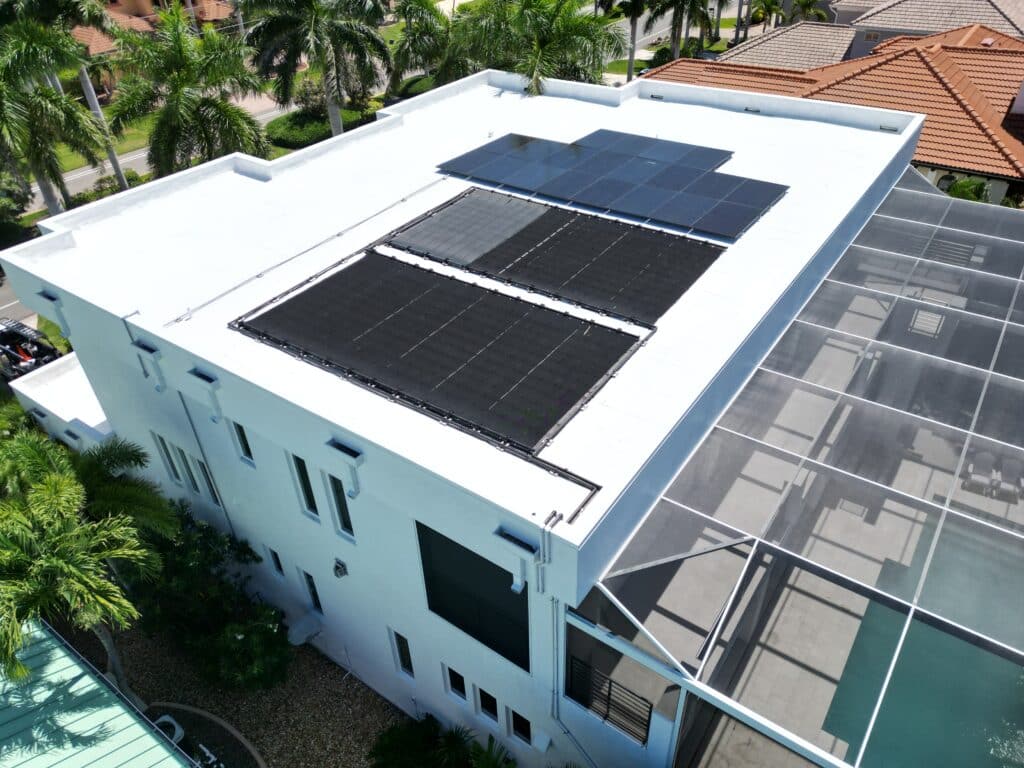
Solar panels for pool heating are thermal collectors. They capture the sun’s heat and pass it straight to your pool water. Solar electric (PV) panels convert sunlight into electricity that powers your home.
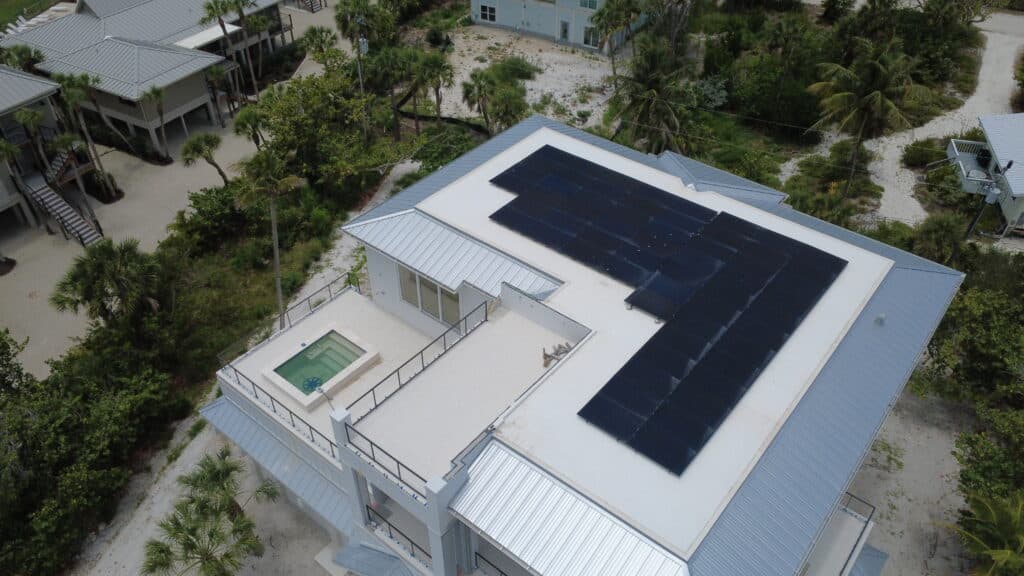
Both make good use of Southwest Florida sunshine, and some homes have room for both on the same roof. Our Naples eco-package project, for example, pairs an 800-square-foot Heliocol pool system with an 11.7 kW solar electric system. When a homeowner wants both, we plan the roof layout for each before installing either one.
Why Solar Pool Heater Installation Matters
A well-built system performs poorly when it is undersized, badly plumbed, or mounted on the wrong side of the roof. Our own in-house team handles solar pool heater installation at Advance Solar & Spa, and we do not subcontract the work. We install Heliocol collectors, design each layout around your pool and roof, and service the system for years after installation.
Most solar pool heaters last 15 to 20 years or more with proper care, and many continue to run well past their warranty period. You can learn more about how long solar pool panels last in Florida.
Put Southwest Florida Sunshine to Work in Your Pool
A solar pool heating evaluation starts with three things already at your home: the pool, the roof, and the equipment on your pad. Our designers measure each one, sketch a collector layout, and explain how solar alone or solar paired with a heat pump would perform for your family’s pool use. Advance Solar & Spa has offered pool heating solutions to homeowners in Southwest Florida from the same Fort Myers location since 1983.
We install solar pool heating throughout Fort Myers, Cape Coral, Naples, Bonita Springs, Estero, Sanibel, Marco Island, Punta Gorda, Port Charlotte, and nearby communities. If you are adding a heat pump for an Endless Summer setup, ask about pool heat pump financing.
Schedule a solar pool heating evaluation or call (239) 427-2048 to talk with our pool heating team.
Frequently Asked Questions About Solar Pool Heating in Florida
How does solar pool heating work in Florida?
Your existing pool pump sends water through roof-mounted collectors, where the sun warms it, and then returns it to the pool. The pool stores the heat, so no tank or heat exchanger is needed. When the pump shuts off, the collectors typically drain back to the pool.
How much warmer will solar pool heating make my pool?
A properly sized system can typically raise pool water about 10 to 15 degrees Fahrenheit above its natural temperature. Actual results depend on weather, collector size, pool size, wind exposure, and pool use. A pool blanket helps hold that heat overnight.
Is solar pool heating worth it in Florida?
For many Southwest Florida homeowners, yes. The sun provides heat at no cost once the system is installed; the collectors have few moving parts and often last 15 to 20 years or more. Whether it fits your home depends on your roof, shading, and how warm you want the water to be.
How much does a solar pool heater cost?
Solar pool heater cost depends on your pool’s surface area, roof orientation, the number of collectors, plumbing distance, and whether you add automatic controls. Operating cost stays low because the pool pump is the only electrical load. A site evaluation gives you a price for your specific pool and roof.
Do Florida solar pool heaters need glycol?
Usually not. Glycol systems protect collectors in climates with long, hard freezes. A conventional unglazed solar pool heating system in Southwest Florida circulates pool water directly and drains when the pump stops.
Does solar pool heating work on cloudy days or in winter?
It works on cloudy days at reduced output, and sunny days deliver the biggest temperature gain. In winter, a properly sized system can keep the pool comfortable through much of the season. Many homeowners add a heat pump for cold fronts and long cloudy stretches.
How long do solar pool heaters last?
Most solar pool heaters last 15 to 20 years or more with proper care. Many continue to operate efficiently past their warranty period. Systems with few moving parts need service primarily when a component needs repair or replacement.
Can I use solar pool heating with my existing heat pump or gas heater?
Yes. Many customers use solar as their primary heat source and keep a heat pump or gas heater as a backup. We call the solar-and-heat-pump combination our Endless Summer package.
Will solar pool heating panels damage my roof?
No. Solar pool heating panels are installed with industry-approved mounting methods that protect the roof. On standing-seam metal roofs, we use S-5! hardware that installs without roof penetrations.
Find more answers in our Pool Heater FAQs and Heat Pump FAQs.