Enphase IQ8 Microinverter Datasheet: Full Electrical Specs
-
Share
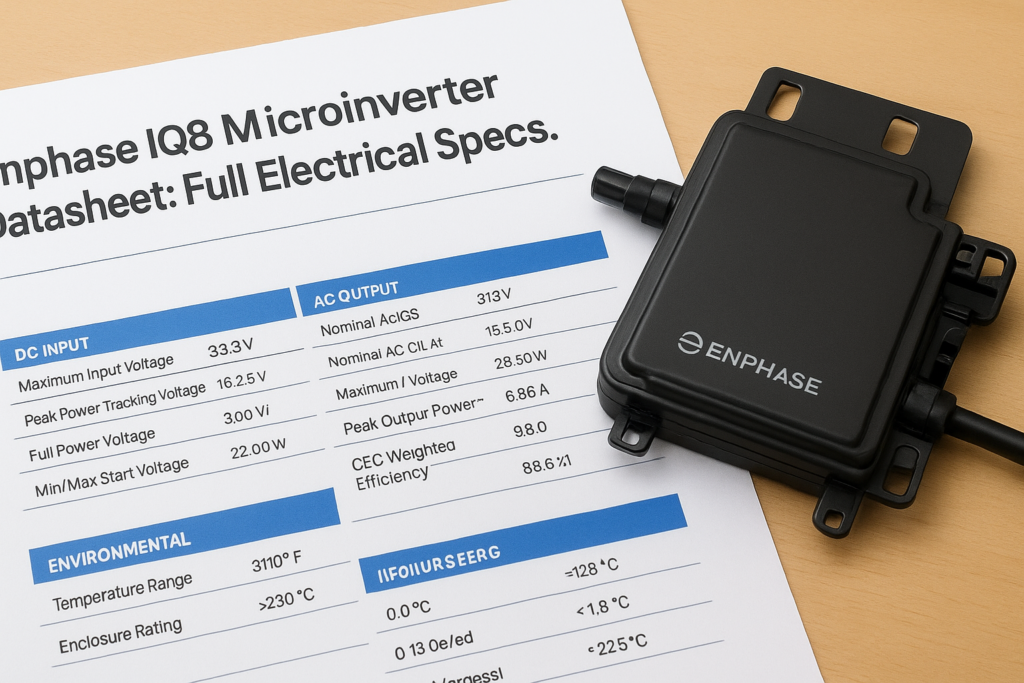
Choosing the right microinverter starts with understanding what’s on the spec sheet. The Enphase IQ8 microinverter datasheet contains everything you need to evaluate before committing to a system, output ratings, efficiency percentages, module compatibility, operating temperature ranges, and warranty terms. But raw numbers on a PDF don’t always tell the full story, especially when you’re trying to match components to Florida’s specific climate and grid conditions.
As an Enphase Platinum Installer with over 40 years and 50,000+ installations across Florida, Advance Solar & Spa works with the IQ8 lineup daily. Our engineering team reviews these specs not just on paper but in the field, on rooftops in Fort Myers, Naples, Sarasota, and Fort Lauderdale. That hands-on experience gives us a practical perspective on how each IQ8 model actually performs, beyond what the datasheet alone can communicate.
This article breaks down the full electrical specifications for every IQ8 variant, explains what each number means for your system’s real-world performance, and provides direct links to the official Enphase documentation. Whether you’re a homeowner comparing proposals, an installer verifying compatibility, or simply doing your homework before going solar, you’ll find the technical detail you need organized in one place, with context that helps you make sense of it all.
What the IQ8 datasheet tells you
The Enphase IQ8 microinverter datasheet is a multi-page technical document that covers every measurable characteristic of the device. You’ll find three main categories of data inside: DC input specs that govern which solar modules work with the inverter, AC output specs that determine grid performance, and environmental ratings that tell you whether the unit handles Florida’s heat and humidity. Reading all three categories together gives you a complete picture of how the hardware fits your system.
DC Input Specifications
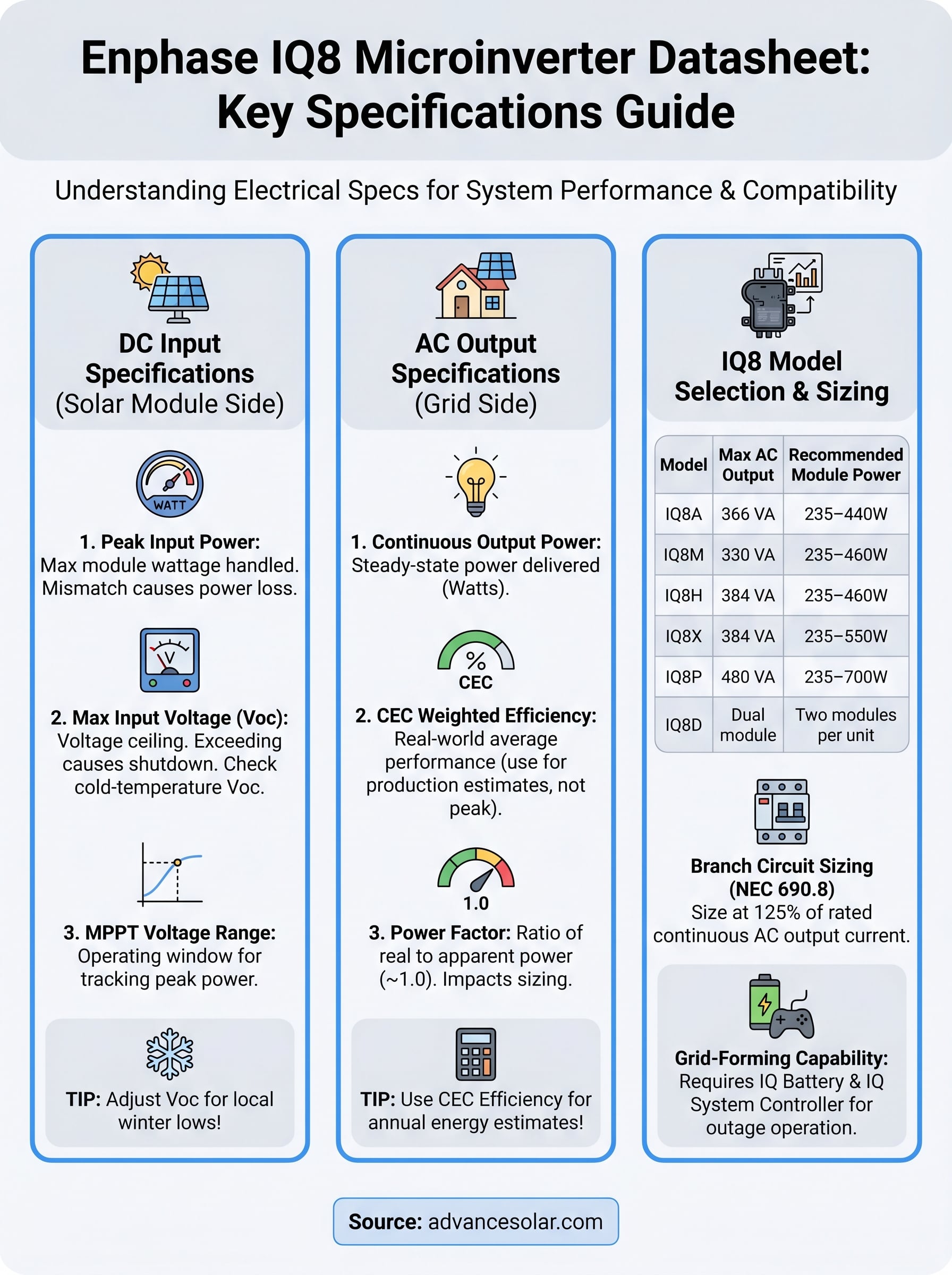
The DC side of the datasheet defines what the microinverter can accept from your solar panels. Peak input power is the maximum wattage the inverter can handle, and maximum input voltage (Voc) sets the ceiling for the open-circuit voltage your panel can produce. If your panel’s Voc exceeds that ceiling, the inverter will shut down to protect itself. You should also check the MPPT voltage range, which is the operating window where the inverter actively tracks peak power from the module.
Mismatching a high-voltage panel to a low-tolerance inverter is one of the most common and avoidable spec errors in residential solar design.
AC Output Specifications
The AC side tells you what power the inverter delivers to your home’s electrical system. Continuous output power (rated in watts) shows the steady-state capacity, while peak apparent power (VA) reflects the maximum short-term load. You’ll also see the weighted CEC efficiency, which is a standardized real-world efficiency figure calculated under variable irradiance conditions. That number is more useful than peak efficiency for estimating actual annual production in Florida.
Environmental and Mechanical Ratings
Ambient operating temperature range and ingress protection (IP) rating tell you how well the hardware survives outdoor exposure. The IQ8 series carries an IP67 rating, meaning the unit resists full dust ingress and temporary water immersion, which matters on a Florida roof during hurricane season.
IQ8 model lineup and how to choose
Enphase offers six primary IQ8 variants, each optimized for a different panel wattage and output range. Picking the right one from the Enphase IQ8 microinverter datasheet comes down to matching the inverter’s input limits to your specific solar module before you finalize any equipment order.
The six IQ8 variants
Each model targets a specific power class and a recommended module wattage range. Use the table below as your starting reference:
| Model | Max AC Output | Recommended Module Power |
|---|---|---|
| IQ8A | 366 VA | 235–440W |
| IQ8M | 330 VA | 235–460W |
| IQ8H | 384 VA | 235–460W |
| IQ8X | 384 VA | 235–550W |
| IQ8P | 480 VA | 235–700W |
| IQ8D | Dual module | Two modules per unit |
Matching the model to your panel
Your panel’s peak power (Wp) and open-circuit voltage (Voc) are the two numbers that narrow your choice fastest. If your module produces more than the inverter’s rated input power, you lose production capacity and risk triggering protection thresholds.
Oversizing your panel relative to the inverter by more than 15–20% typically results in measurable clipping losses during Florida’s long summer days.
For most residential installs using standard 400W panels, the IQ8M or IQ8A fits well. Larger 500W-plus modules generally point toward the IQ8X or IQ8P.
Key electrical specs to read correctly
The numbers on the enphase iq8 microinverter datasheet carry specific meanings that aren’t always obvious at first glance. Two specs trip up most buyers: CEC weighted efficiency and the gap between peak output power and continuous output power. Understanding both correctly prevents you from overestimating annual production or undersizing your electrical components.
CEC Efficiency vs. Peak Efficiency
CEC weighted efficiency is the figure to use when running production estimates. It averages inverter performance across multiple irradiance levels rather than measuring only under ideal lab conditions. Peak efficiency represents the absolute best-case scenario and rarely reflects what a unit delivers across a full Florida year of variable cloud cover and temperature swings.
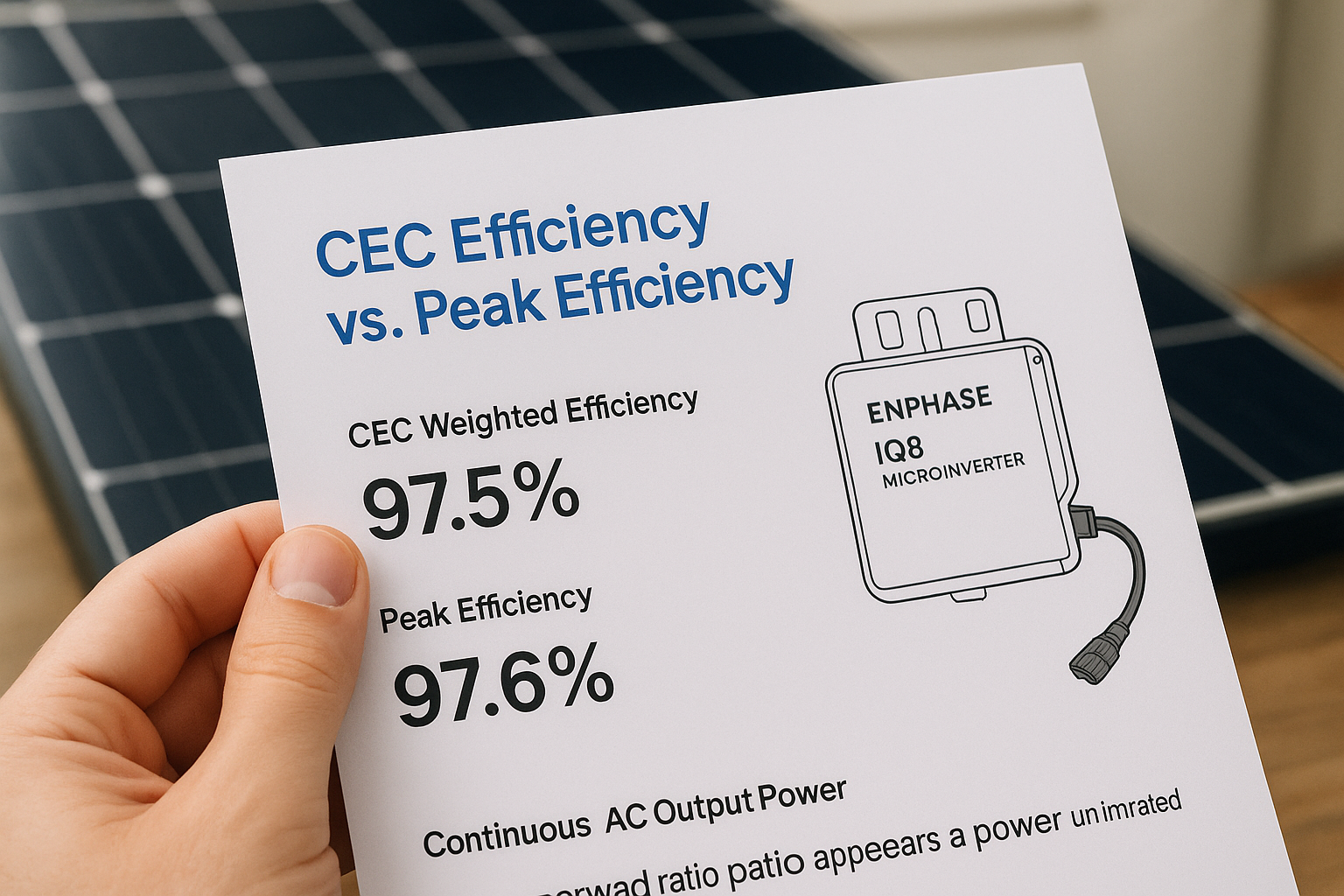
Use CEC weighted efficiency, not peak efficiency, when calculating expected annual energy output in any design tool.
Output Power and Power Factor
Continuous AC output power (watts) tells you the steady power the inverter delivers under normal operation. Power factor is the ratio of real power to apparent power and appears on the datasheet as a value close to 1.0. A lower power factor means the inverter delivers less usable real power relative to the current it draws.
Pull these two numbers before any design review:
- Rated continuous output power for sizing string totals
- Power factor for confirming breaker and conductor sizing
Compatibility, limits, and branch circuit sizing
The enphase iq8 microinverter datasheet sets three hard limits that determine which solar modules pair safely with each unit: maximum DC input voltage (Voc), maximum short-circuit current (Isc), and the MPPT voltage range. Exceeding any single limit triggers a protection shutdown and reduces your system output.
Module compatibility requirements
Your panel’s cold-temperature Voc must stay below the inverter’s maximum input voltage. Florida’s occasional winter lows can push Voc above standard test condition values, so calculate adjusted Voc before placing any equipment order.
Use your local record low temperature, not standard test conditions, when checking panel Voc against the inverter’s voltage ceiling.
Verify these three values before finalizing your design:
- Panel Voc (cold temp adjusted) vs. inverter max input voltage
- Panel Isc vs. inverter max input current
- Panel Vmp operating range vs. inverter MPPT window
Branch circuit sizing
NEC 690.8 requires conductors and breakers to be sized at 125% of the inverter’s rated AC output current. Each IQ8 model lists its maximum continuous output current on the datasheet, and that number directly drives your electrical design.
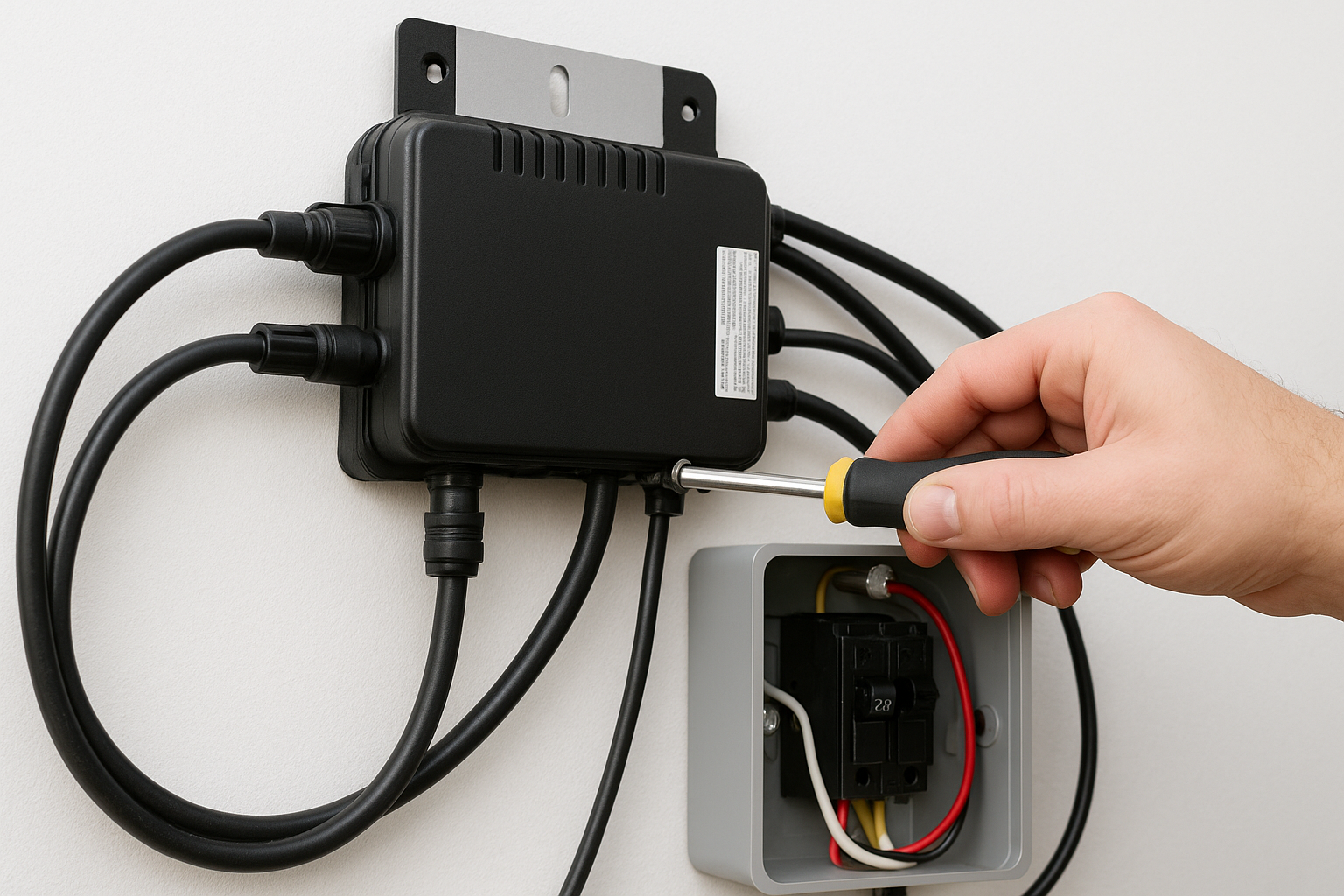
For a standard 20-amp branch circuit, the continuous load limit after applying the 125% derate is 16 amps. Count the total rated output current for every microinverter on each run and confirm you stay within that ceiling before finalizing your branch layout.
Common questions and spec pitfalls
Two questions come up repeatedly when people review the enphase iq8 microinverter datasheet for the first time: whether the IQ8 operates during a grid outage, and whether the rated output wattage equals the panel wattage. Both questions point to the same underlying confusion between DC input specs and AC output specs.
Does the IQ8 work during a grid outage?
Standard IQ8 units do not produce power during a grid outage on their own. Grid-forming capability requires pairing the IQ8 with an Enphase IQ Battery and an IQ System Controller. Without those components, the inverter shuts down when grid voltage disappears.
If backup power is part of your goal, confirm battery and system controller compatibility before finalizing your equipment list.
Three spec pitfalls that cost you production
Some spec errors show up consistently across installs and cost you production before anyone notices. Watch for all three before submitting a design:
- Confusing rated watts with VA: Watts measure real power; VA measures apparent power. Use rated watts for production estimates.
- Ignoring the MPPT floor: Panels that drop below the inverter’s minimum MPPT voltage during low-light conditions produce nothing.
- Skipping cold-temperature Voc adjustment: Even Florida winters can push panel voltage above the inverter’s input ceiling.
Quick recap
The Enphase IQ8 microinverter datasheet gives you the complete technical picture for every IQ8 variant, from DC input limits and MPPT voltage ranges to CEC weighted efficiency and branch circuit sizing requirements. Reading those numbers correctly before finalizing your equipment order prevents the most common and costly design mistakes.
Matching your panel’s cold-temperature Voc and Isc to the right IQ8 model, sizing your branch circuits at 125% of rated output current, and using CEC weighted efficiency for production estimates are the three steps that separate a well-designed system from one that underperforms from day one.
With over 50,000 installations across Florida and status as an Enphase Platinum Installer, Advance Solar & Spa has the engineering experience to verify your specs and build a system that delivers what the datasheet promises. If you want a team that reads these numbers in the field every day, reach out to Advance Solar & Spa to get started.