What Does a Solar Inverter Do? DC-To-AC Explained For Homes
-
Share
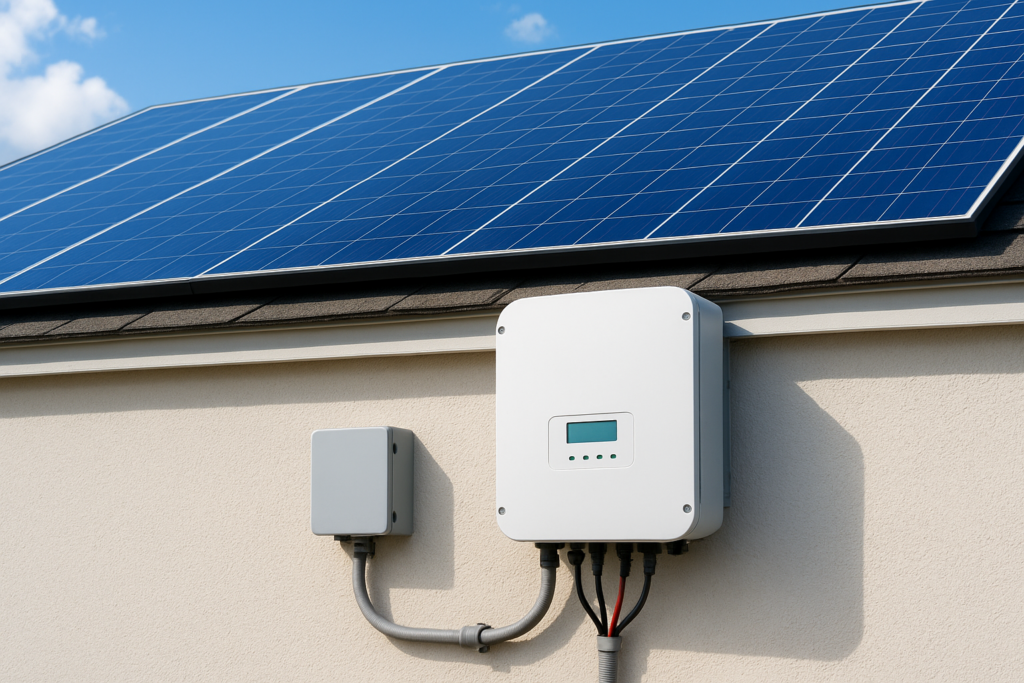
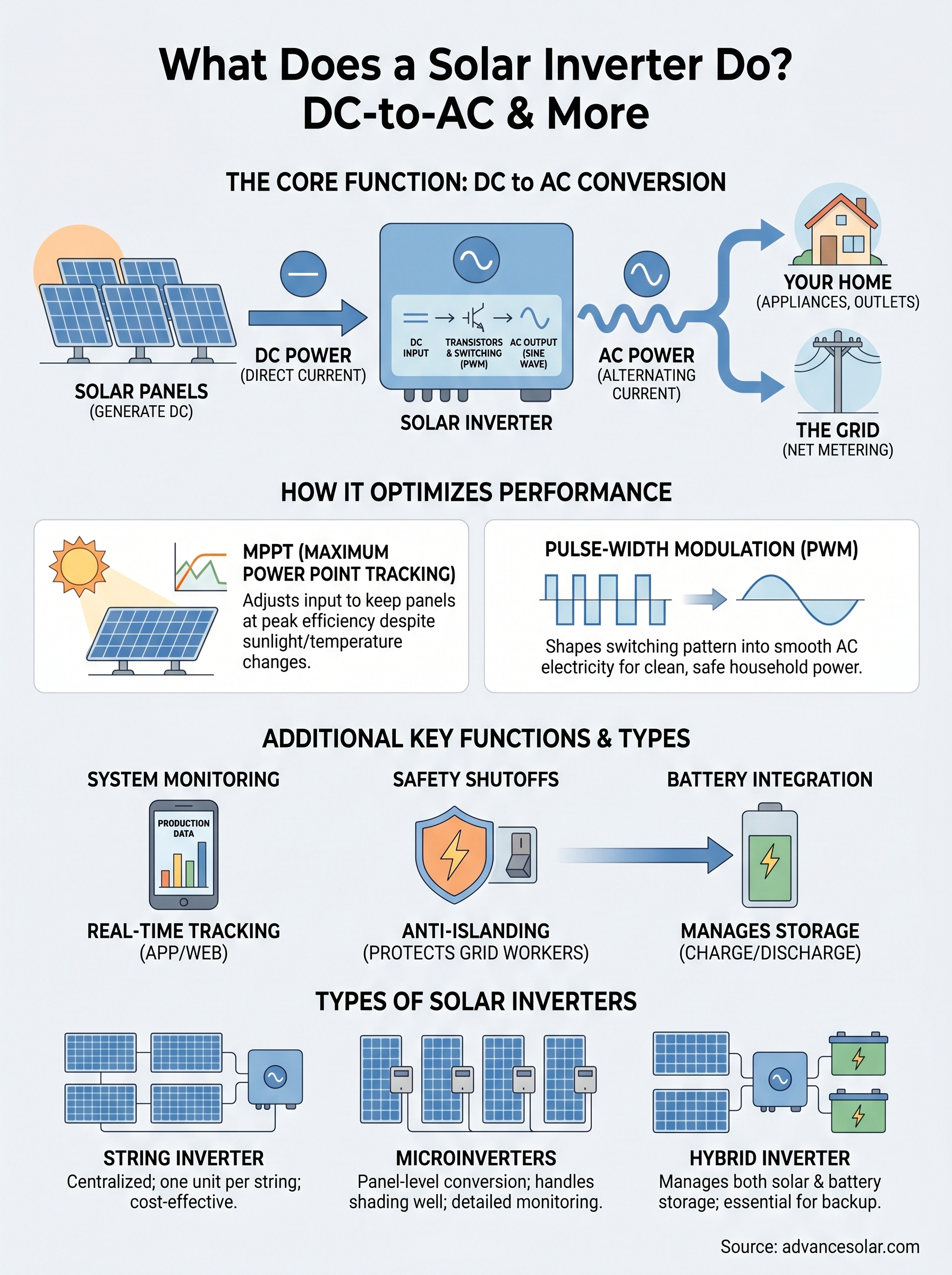
Your solar panels produce electricity the moment sunlight hits them, but that electricity isn’t ready for your home yet. So what does a solar inverter do, exactly? It takes the direct current (DC) your panels generate and converts it into alternating current (AC), which is the type of electricity your appliances, lights, and outlets actually use.
Without an inverter, your solar panels are essentially useless to your household. It’s the component that bridges the gap between raw solar energy and the power running through your walls. The inverter also handles critical tasks like system monitoring and safety shutoffs, making it one of the hardest-working pieces of equipment on your roof or garage wall. Yet most homeowners never think about it until something goes wrong.
At Advance Solar & Spa, we’ve designed and installed over 50,000 solar systems across Florida since 1983. Our in-house engineering team selects, sizes, and installs inverters daily, so we’ve seen firsthand how the right inverter choice affects a system’s performance and lifespan. This article breaks down how solar inverters work, the different types available, and what matters most when one is powering your home.
Why solar inverters matter in a home system
Most homeowners focus on the solar panels themselves, and that makes sense. Panels are visible, tangible, and straightforward to understand. But the inverter is what actually determines how much of your solar energy becomes usable electricity in your home. A mismatched or underperforming inverter limits the output of even the best panels on the market. When you dig into what does a solar inverter do, the answer goes well beyond simple conversion. It acts as the operational core of your entire solar setup, connecting your panels, your home, the grid, and any battery storage you have into a single working system.
The inverter ties your system to the grid and your home
Your home runs on AC power at 120 or 240 volts, which is the same standard your utility company delivers. Solar panels produce DC power at voltages that shift constantly based on sunlight intensity, temperature, cloud cover, and partial shading. The inverter bridges that gap in real time, adjusting its output to match what your home and the grid both require at any given moment.
Grid-tied systems rely on the inverter to synchronize with utility power without interruption. When your panels produce more electricity than your home needs, the inverter routes the surplus back to the grid, which is how net metering credits accumulate on your monthly bill. When production drops below your demand, it draws from the grid automatically without any action on your part. That continuous balancing act only functions because the inverter monitors and manages both sides of the energy flow simultaneously.
The inverter doesn’t just convert power. It actively manages the movement of electricity between your panels, your home, and your utility at all times.
Your inverter protects your home and the grid
Modern inverters include built-in safety functions that protect both your electrical equipment and utility workers in the field. One of the most important is anti-islanding protection. If the grid goes down for any reason, the inverter shuts off automatically to prevent your system from sending live electricity into lines that crews may be working on. This protection is not optional. Florida utility interconnection standards and the National Electrical Code both require it for all grid-tied systems.
Inverters also protect your equipment from common electrical hazards. They continuously monitor for voltage spikes, frequency irregularities, and output anomalies, responding by throttling production or shutting down before damage occurs. In Florida, where lightning strikes and sudden grid fluctuations happen regularly, this layer of built-in protection is particularly valuable. Without it, a single surge event could damage your panels, your home appliances, or your battery storage system.
How a solar inverter converts DC power to AC power
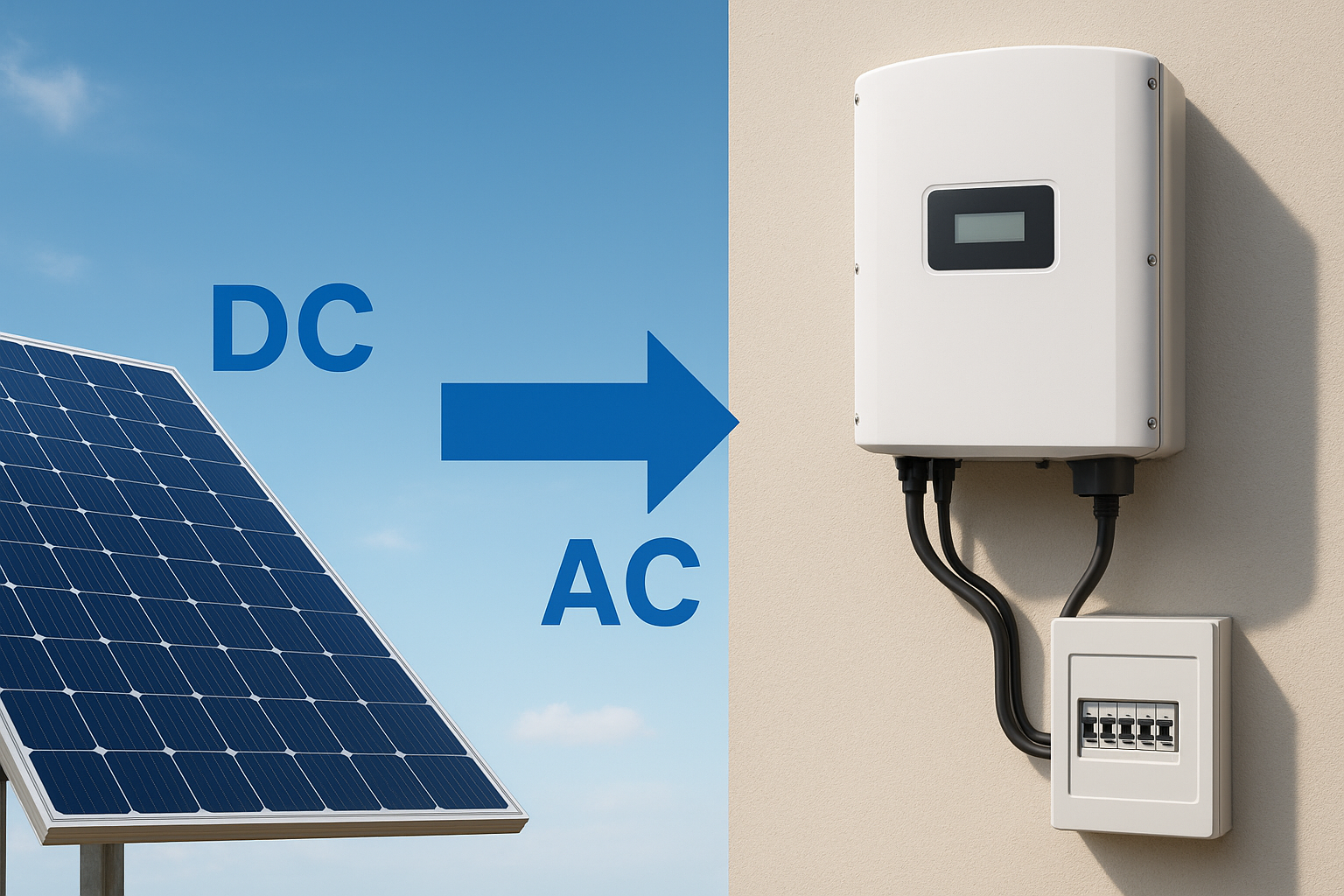
Solar panels generate electricity through the photovoltaic effect, where photons from sunlight knock electrons loose in silicon cells, creating a one-directional flow of current. That one-directional movement is direct current (DC), and it’s stable and efficient for moving through wiring but incompatible with the way your home’s electrical system operates. Your breaker panel, outlets, and appliances all expect alternating current, which reverses direction many times per second.
The switching process inside the inverter
The inverter converts DC to AC using high-speed electronic switches called transistors, which rapidly flip the direction of current back and forth. Modern inverters use a process called pulse-width modulation (PWM) to shape that switching pattern into a smooth sine wave matching the 60 Hz frequency of the US electrical grid. The result is clean, stable AC power that your home treats exactly like utility electricity.
The quality of that sine wave matters. A poor-quality output causes appliances to run inefficiently or generate excess heat, which shortens their lifespan over time.
How the inverter tracks maximum power output
Beyond the basic conversion process, the inverter continuously runs an algorithm called maximum power point tracking (MPPT). Sunlight intensity, panel temperature, and shading all shift the optimal operating voltage of your panels throughout the day. MPPT adjusts the input voltage in real time to keep your panels running at their most efficient output level, rather than losing usable energy to minor changes in conditions. Understanding what a solar inverter does at this level explains why inverter quality affects your total annual energy production just as much as panel quality does. A well-matched inverter recovers energy that a poorly-sized one simply wastes.
What else a solar inverter does besides conversion
When you ask what does a solar inverter do, conversion is the obvious answer. But modern inverters carry out several additional functions that directly affect how much energy you capture and how reliably your system operates over its lifetime. Understanding these functions helps you make sense of your system’s behavior and get the most out of your investment.
System monitoring and performance reporting
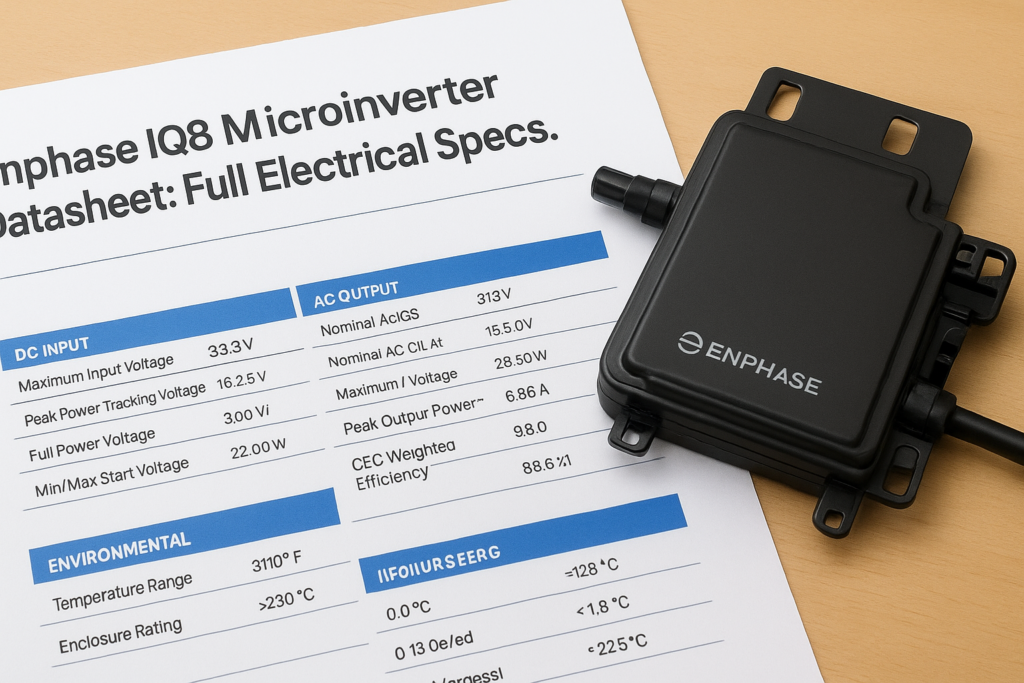
Your inverter tracks production data in real time and sends it to a connected app or web portal, giving you a clear view of how much electricity your panels generate at any moment. Brands like Enphase provide detailed panel-level data through their Enlighten platform, so you can see exactly which panel is underperforming and why. That visibility helps you and your installer catch problems early, before a shading issue or equipment fault quietly reduces your annual energy output for months without your knowledge.
Monitoring isn’t a bonus feature. It’s how you verify that your investment is producing what it was designed to produce.
Historical data logging gives your installer the ability to review system behavior remotely during a service call. Many performance issues get diagnosed and resolved without a site visit, saving you both time and out-of-pocket service costs.
Battery storage communication
If your system includes battery backup, the inverter manages the charging and discharging cycles for that storage. It determines when to store excess solar energy, when to release it into your home, and how to prioritize battery reserve during grid outages. Systems built around Tesla Powerwall or Enphase IQ Battery rely on the inverter to coordinate this behavior automatically based on your settings and grid conditions.
Some inverters also support export limiting, which restricts how much electricity your system sends to the grid. Certain Florida utilities require this, and a properly configured inverter handles grid compliance automatically without any manual intervention on your part.
Types of solar inverters used in homes
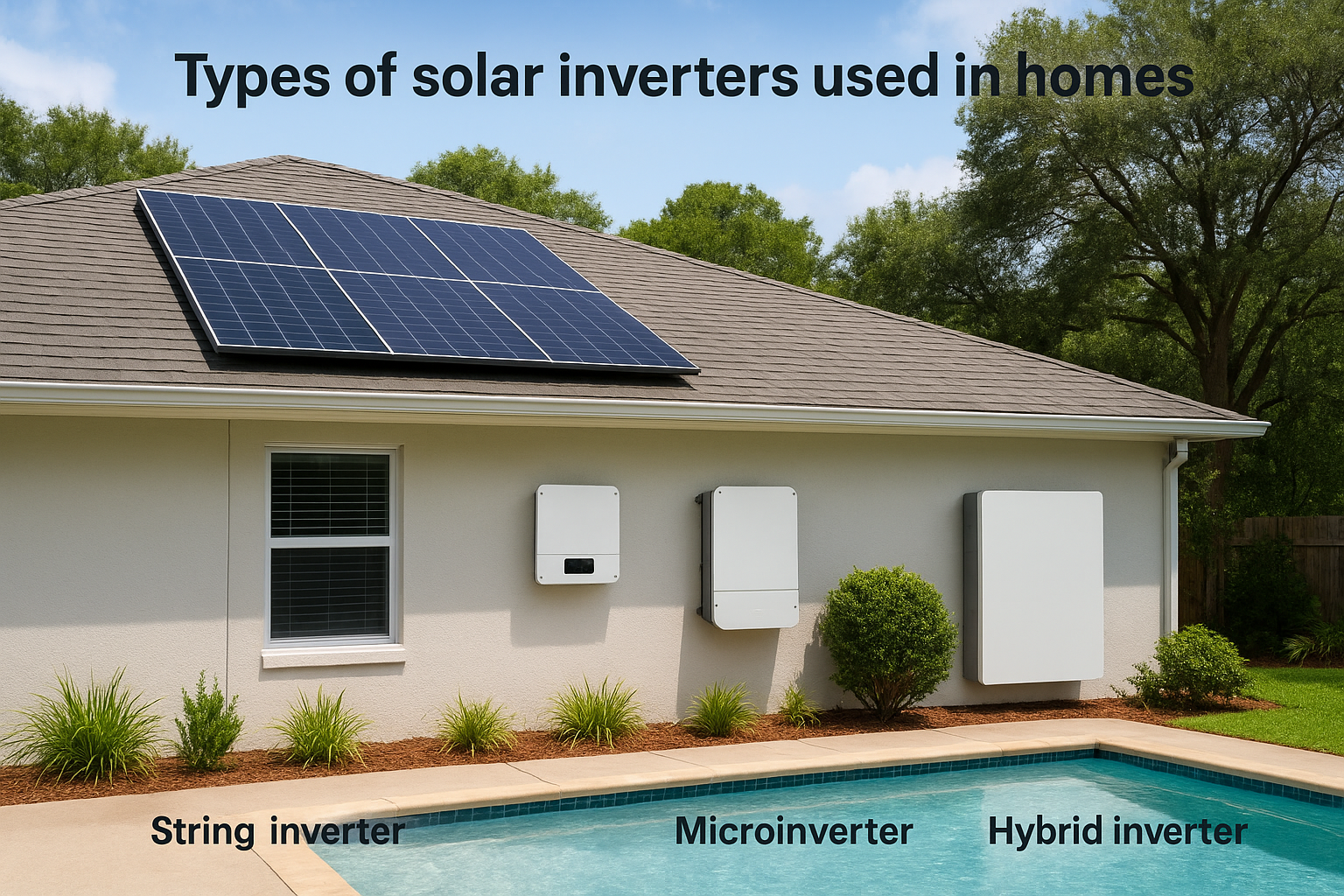
Not every inverter is built the same way, and the type you install shapes how your system handles shading, roof layout, and battery integration. Florida homes come in all shapes, with complex rooflines, pool equipment, and trees that create shading challenges. Knowing the main inverter types helps you understand why your installer recommends one over another.
String inverters
A string inverter connects a series of panels into one circuit, called a string, and processes all of their output through a single central unit. This setup is cost-effective and has a long track record of reliability. The main limitation is that shading or a fault on one panel drags down the output of every panel in that string. For homes with simple south-facing rooflines and minimal shading, string inverters still deliver strong performance at a lower upfront cost.
Microinverters
Microinverters attach directly to each individual panel, converting DC to AC at the panel itself rather than at a central location. This design means one shaded or underperforming panel has no effect on the rest of your array. Enphase, one of the brands Advance Solar & Spa installs as a Platinum Enphase Installer, leads this category with detailed panel-level monitoring built into every unit.
Microinverters are often the better choice for homes with multiple roof faces, partial shading, or plans to expand the system later.
Hybrid inverters
Hybrid inverters handle both solar conversion and battery storage management in a single unit. They communicate directly with systems like the Tesla Powerwall to control when your home draws from solar, stores energy, or pulls from the grid. If you’re asking what does a solar inverter do in a battery-backed setup, the hybrid inverter is the component doing all of that coordination automatically and continuously.
How to choose the right inverter for your home
Choosing the right inverter comes down to three factors: your roof’s layout, your shading conditions, and whether you plan to add battery storage. Getting this decision right from the start prevents costly retrofits later and ensures your system delivers on its full energy production potential rather than falling short of your installer’s estimates.
Match the inverter to your roof and shading situation
If your roof has a single unobstructed south-facing surface and minimal shading from trees or nearby structures, a string inverter handles the job cleanly at a lower upfront cost. But if your home has multiple roof angles, a chimney, or landscaping that creates partial shading at any point during the day, microinverters recover significantly more energy because each panel operates independently of the others. Florida homes with pool equipment, pergolas, or tall palms nearby often benefit from that panel-level isolation more than homeowners expect.
Before your installer finalizes a recommendation, answer these questions:
- How many roof faces does my array span?
- Are there shading sources that affect any panels during peak production hours?
- Do I want battery backup now or within the next five years?
- What monitoring platform does this inverter support?
Decide on battery backup before you buy
If there’s any chance you’ll add a battery system in the future, selecting a hybrid inverter now avoids replacing hardware later. Understanding what does a solar inverter do in a backup scenario makes the compatibility question straightforward: the inverter must communicate directly with your battery to manage charging, discharging, and grid interaction without additional conversion equipment in between.
Choosing based on upfront cost alone often costs more over 25 years when an incompatible inverter requires full replacement before battery storage can be added.
A standard string inverter without hybrid capability typically needs additional hardware or a complete inverter swap to support a Tesla Powerwall or Enphase IQ Battery. That added cost and system downtime is avoidable when you plan battery integration from the start.
Next steps for your solar setup
Now that you understand what does a solar inverter do and how it shapes your system’s total output, the next step is applying that knowledge to your specific home. Your roof layout, shading conditions, and battery backup goals all determine which inverter type delivers the best return on your investment, and choosing correctly from day one prevents costly hardware replacements later. A licensed solar engineer can assess your property, model your annual production, and recommend the inverter configuration that fits your situation without overselling equipment you don’t need.
Advance Solar & Spa has designed and installed over 50,000 solar systems across Florida since 1983, using in-house licensed engineers rather than subcontractors. As a Tesla Certified Installer and Enphase Platinum Installer, we carry the inverter brands that hold up reliably in Florida’s heat, humidity, and storm conditions. If you’re ready to move forward, get a free solar energy analysis from Advance Solar & Spa and find out exactly what your home qualifies for.