What Is Net Metering? How Solar Credits Work On Your Bill
-
Share
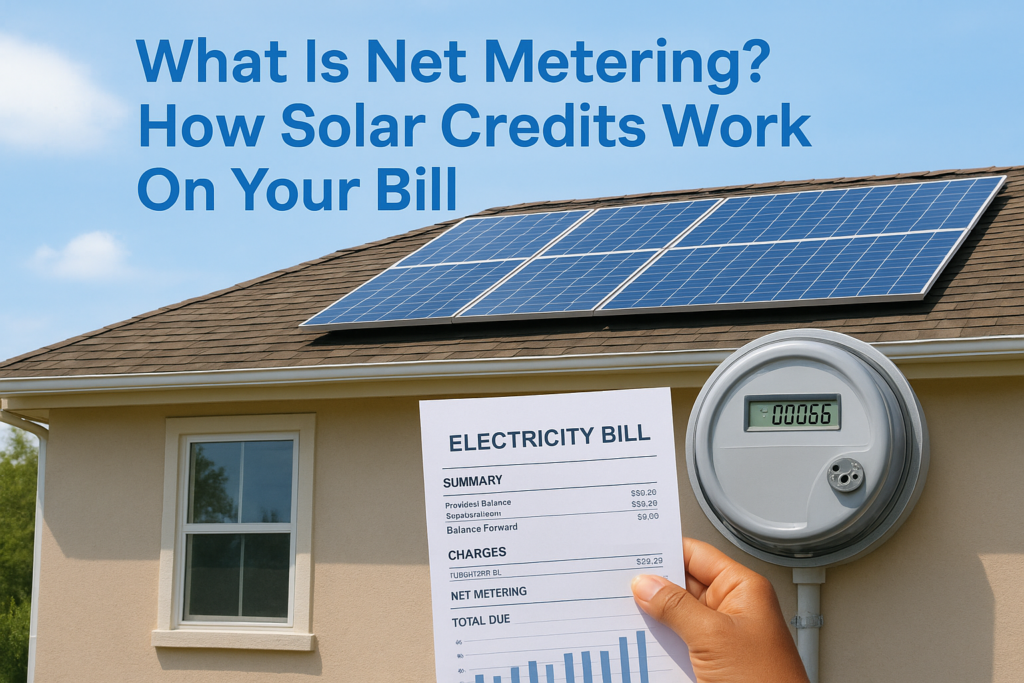
You installed solar panels, your system is producing more electricity than your home uses during the day, and now you’re wondering where all that extra power goes. That’s exactly where what is net metering comes in, and understanding it is the difference between hoping your solar investment pays off and knowing exactly how it does.
Net metering is the billing arrangement between you and your utility company that determines how you get credit for the surplus electricity your panels send to the grid. It’s not complicated, but the details matter, especially in Florida, where sunshine is abundant and utility rates keep climbing. Getting this right can shave thousands off your electricity costs over the life of your system. Getting it wrong means leaving money on the table.
At Advance Solar & Spa, we’ve designed and installed over 50,000 solar energy systems across Florida since 1983. Our in-house team of certified solar consultants walks every customer through the net metering process, from application to seeing those credits appear on your bill. In this article, we’ll break down exactly how net metering works, how the credits show up on your utility statement, and what Florida homeowners need to know to get the most out of their solar panels.
Net metering in plain English
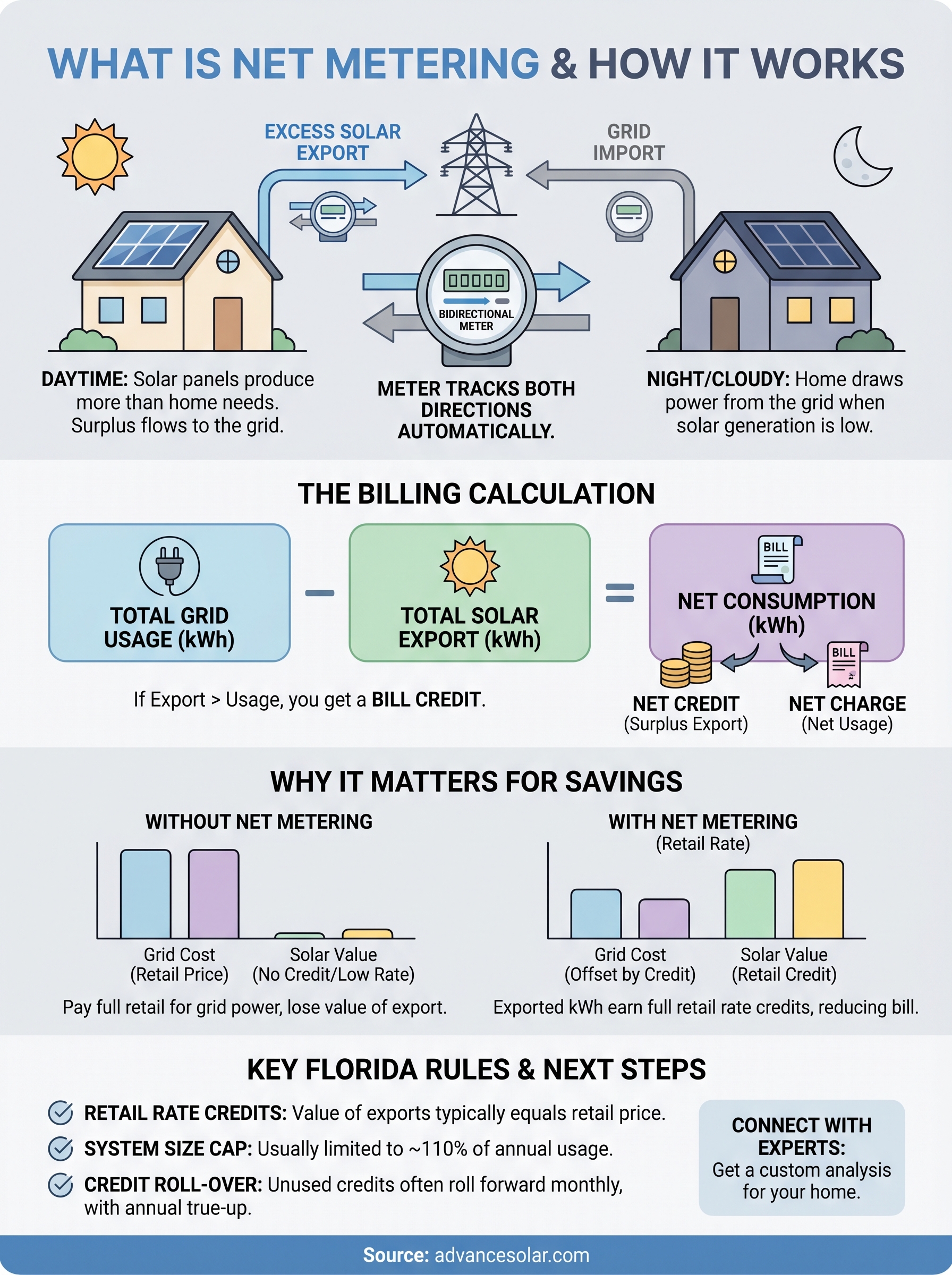
Think of net metering as a running tab between you and your utility company. During the day, your solar panels often produce more electricity than your home actually uses, particularly during peak sun hours. That surplus power flows back into the public grid, and your utility tracks every kilowatt-hour (kWh) you contribute. At night or on cloudy days, the process reverses, and your home draws power from the grid like any other house on the block.
How your meter tracks electricity in both directions
Your utility installs a bidirectional smart meter on your home when you connect a solar system to the grid. This device measures two separate flows: electricity coming in from the grid when your panels fall short, and electricity going out to the grid when your panels overproduce. Older single-direction meters cannot handle this job. Net metering meters log both directions with equal precision, recording everything you consume and everything you export.
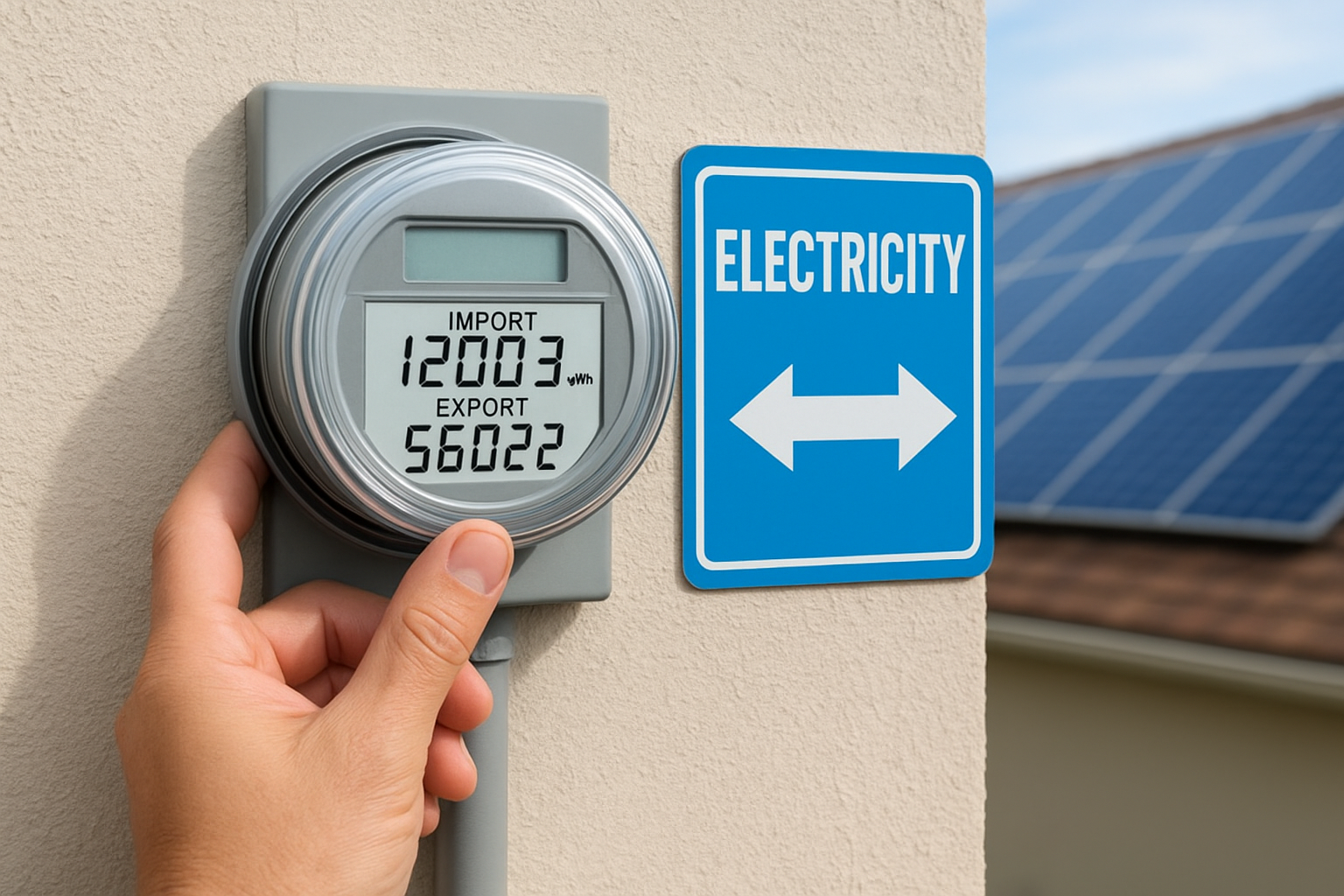
This two-way tracking happens automatically, every minute of every day. When Florida afternoon clouds roll in and your panels underperform, the meter records every kWh your home pulls from the grid. When it’s a clear noon in July and your panels are running at full output while the house sits empty, every surplus kWh flows outward and lands as a credit on your account.
Net metering turns your rooftop solar system into a two-way financial tool, earning credits every hour the sun outpaces your home’s demand.
The math behind your monthly credit
The term “what is net metering” makes the most sense when you look at the actual billing calculation. Your utility takes the total electricity you pulled from the grid and subtracts the total electricity you pushed back to it. Whatever remains is your net consumption for the month. If you sent more than you used, you end the billing period with a credit balance instead of a charge.
Here’s a concrete example. Your home uses 1,000 kWh in a month. Your panels produce 800 kWh on-site and export an additional 300 kWh during peak production hours. You drew 200 kWh from the grid but contributed 300 kWh, so you finish the month 100 kWh ahead. That surplus rolls forward as a dollar-value credit on your next statement. Most traditional net metering programs value exported electricity at the full retail rate, meaning you receive the same price per kWh that you’d pay to buy power from the grid, making the exchange as financially favorable as possible for solar owners.
Why net metering matters for solar savings
Solar panels have a fundamental production mismatch: they generate electricity during daylight hours, but your home consumes power around the clock. Without a mechanism to capture the value of daytime overproduction, you’d lose significant financial benefit from your system. Net metering bridges that gap, converting every surplus kilowatt-hour into a concrete financial offset rather than wasted energy that disappears into the grid with nothing in return.
The cost of electricity without net metering
Florida utility rates have climbed steadily over the past decade, and without net metering, solar owners would face a lopsided deal. Your panels produce excess power during the day, the utility takes it, and you pay full retail price when you draw power at night. Understanding what is net metering makes it clear why the billing structure is so critical: the difference between retail-rate credits and no credits can add up to hundreds of dollars per year on a typical Florida home.
The retail-rate credit structure is what makes net metering one of the most powerful financial tools available to solar homeowners.
How credits reduce your annual bill
Net metering credits accumulate month after month. During the high-production summer months, when your panels generate far more power than your air conditioner consumes, credits pile up on your account. You then spend those credits during lower-production months or during stretches of overcast weather, effectively pre-paying your electricity costs with solar energy you already generated.
Many Florida homeowners who size their systems correctly finish the year with a minimal true-up bill, sometimes paying only the fixed utility connection fee. That outcome is only possible because net metering lets your system function as a running account for electricity, storing value each sunny afternoon and releasing it on demand whenever your panels fall short.
How net metering credits show up on your bill
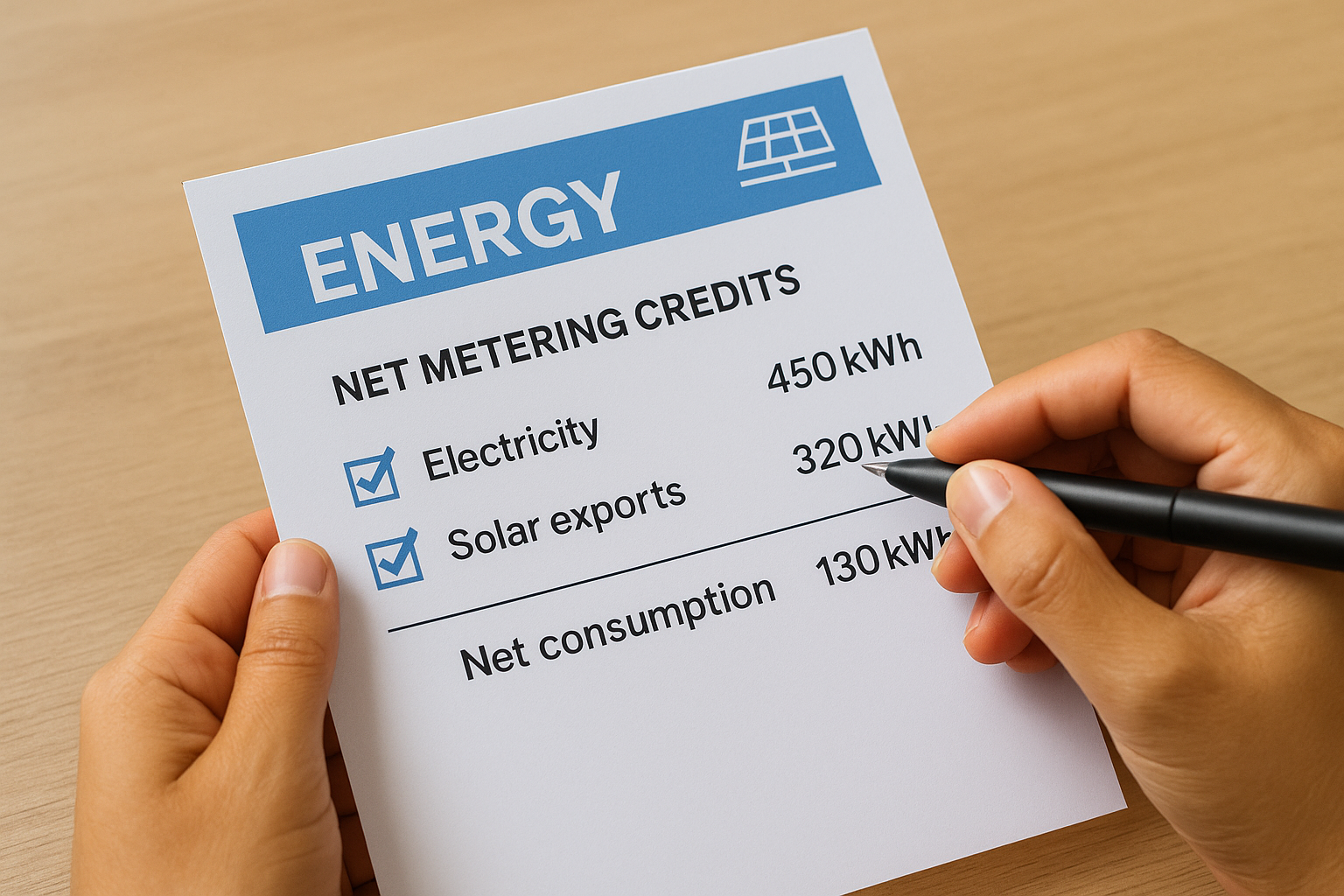
Your monthly utility statement looks different once you go solar, and knowing where to find each line item helps you confirm your system is working correctly. Most utilities break the statement into at least two separate line items: the electricity you drew from the grid and the electricity you exported to it. The difference between those two figures is your net consumption, which is the number that actually determines what you owe or what credit you carry forward.
Reading the generation and export lines
Your bill will typically show a kilowatt-hour total for grid usage alongside a separate figure for solar export credits. Some utilities label the export line as “excess generation” or “energy delivered to grid.” Either way, each exported kWh appears as a credit valued at the full retail rate under most traditional net metering programs, so the credit wipes out an equivalent kWh of charges before any dollar balance is calculated.
Understanding what is net metering becomes very concrete when you compare those two lines side by side. If your export credits exceed your usage charges for the month, your bill shows a zero balance for energy, plus any fixed connection fees your utility charges regardless of consumption. Those fixed fees typically run between $10 and $25 per month and are not offset by solar credits.
What happens when credits exceed your charges
Surplus credits do not simply disappear at the end of a billing cycle. Most utilities roll unused credits forward to the following month, allowing your system to bank value from high-production periods and spend it during lower-production stretches. Florida utilities follow an annual true-up cycle for most customers, meaning the full credit balance accumulates across twelve months before any final reconciliation occurs.
Tracking your credit balance monthly lets you spot any production or metering issues before they cost you money at the annual true-up.
Key rules that change your net metering value
Not every net metering arrangement pays you the same rate, and the specific rules your utility applies can dramatically shift how much financial value your solar system delivers. Three factors carry the most weight: the rate at which your utility compensates exported electricity, any cap on how large your system can be, and how long you’re allowed to carry unused credits before they expire.
Compensation rate: retail versus avoided cost
The most significant variable in understanding what is net metering is the price your utility assigns to each kilowatt-hour you export. Traditional net metering credits you at the full retail rate, the same price you’d pay to buy a kWh from the grid. Some utilities, however, compensate exports at a lower “avoided cost” rate, which reflects only what it costs the utility to generate power, often less than half the retail price. If your utility uses avoided cost pricing, your credits shrink considerably, and your payback period extends.
Confirming your compensation rate before you size your system is one of the most important steps you can take.
System size caps and credit expiration rules
Most utilities impose a maximum system size, typically tied to your home’s average annual electricity consumption. Installing a system larger than that threshold can result in excess production that earns no credit at all, so over-sizing without understanding these limits wastes capital. Florida utilities generally cap systems at 110% of the prior twelve months of usage, which is a reasonable ceiling for most residential customers.
Credit expiration rules add another layer to track. Some utilities expire unused credits annually, meaning any banked kilowatt-hours that remain at your true-up date simply disappear. Others pay out remaining credits at a reduced rate rather than rolling them forward indefinitely. Checking both your cap and your expiration policy ensures your system is sized to earn credits you’ll actually use.
Net metering in Florida and what to ask your utility
Florida law requires investor-owned utilities to offer net metering to residential solar customers, which puts the state in a relatively favorable position compared to states with no mandate at all. That said, understanding what is net metering in Florida specifically means recognizing that the rules are not identical across every utility territory, and your utility’s tariff structure determines your actual credits, not the state law alone.
Florida’s current net metering policy
Florida’s net metering program has faced proposed changes from the Florida Public Service Commission in recent years, so the rules active when you install your system are the ones that lock in your compensation structure going forward. Grandfathering provisions typically protect existing customers for a set number of years, which makes installing sooner rather than later a financially meaningful decision. Each major utility, including FPL, Duke Energy Florida, and TECO, publishes its own net metering tariff, and the details vary enough that you should read your specific utility’s interconnection agreement before signing a solar contract.
Locking in today’s net metering rate before policy changes take effect can protect your savings for a decade or longer.
Questions to ask your utility before you go solar
Getting direct answers from your utility upfront prevents billing surprises after installation. Bring these specific questions to that conversation:
- What rate do you credit for exported kilowatt-hours, retail or avoided cost?
- What is the maximum system size allowed under your net metering tariff?
- Do unused credits roll forward monthly or expire at year-end?
- How long does the interconnection application typically take to process?
- Will my account be grandfathered if the tariff changes after I interconnect?
Your utility’s customer service line or its published interconnection tariff document can answer all of these questions. Documenting the answers in writing before you finalize your system design protects you if policies shift after your panels are installed.
A quick recap and what to do next
Net metering is the billing mechanism that converts your solar system’s surplus electricity into credits that offset your utility charges. Understanding what is net metering means knowing that your bidirectional meter tracks every kilowatt-hour you send to the grid, your utility values those exports at a set rate, and unused credits typically roll forward to reduce future bills. The compensation rate, system size cap, and credit expiration rules at your specific utility determine how much financial value your panels actually deliver.
Florida law requires investor-owned utilities to offer net metering, but the details vary by territory, and policies can change. Installing now locks in the current rate structure before any future adjustments take effect.
If you’re ready to find out exactly how much a solar system would save you under your utility’s net metering tariff, connect with the team at Advance Solar & Spa for a no-pressure energy analysis tailored to your home and utility territory.