
Choosing between a microinverter vs string inverter is one of the first real technical decisions you’ll face when going solar, and it directly affects how your system performs, what you’ll pay upfront, and how long your equipment lasts. Both technologies convert the DC power your panels produce into usable AC electricity, but they do it in fundamentally different ways that matter more than most sales pitches let on.
At Advance Solar & Spa, we’ve installed over 50,000 solar systems across Florida since 1983. As both a Tesla Certified Installer and Enphase Platinum Installer, we work with string inverters and microinverters daily, so we’ve seen firsthand how each technology holds up on real rooftops, through hurricanes, partial shade, and Florida’s relentless heat.
This article breaks down the actual cost differences, shade performance, lifespan expectations, and practical trade-offs between the two inverter types so you can make an informed decision based on your roof, your budget, and your energy goals, not just a brand name.
Why inverter choice changes system output and risk
Your inverter is the brain of your solar system. The panels generate raw DC electricity, but your inverter converts that power into AC electricity your home can actually use. If that conversion process runs into trouble, the impact spreads across every kilowatt-hour your system is supposed to produce.
How the inverter determines system-wide output
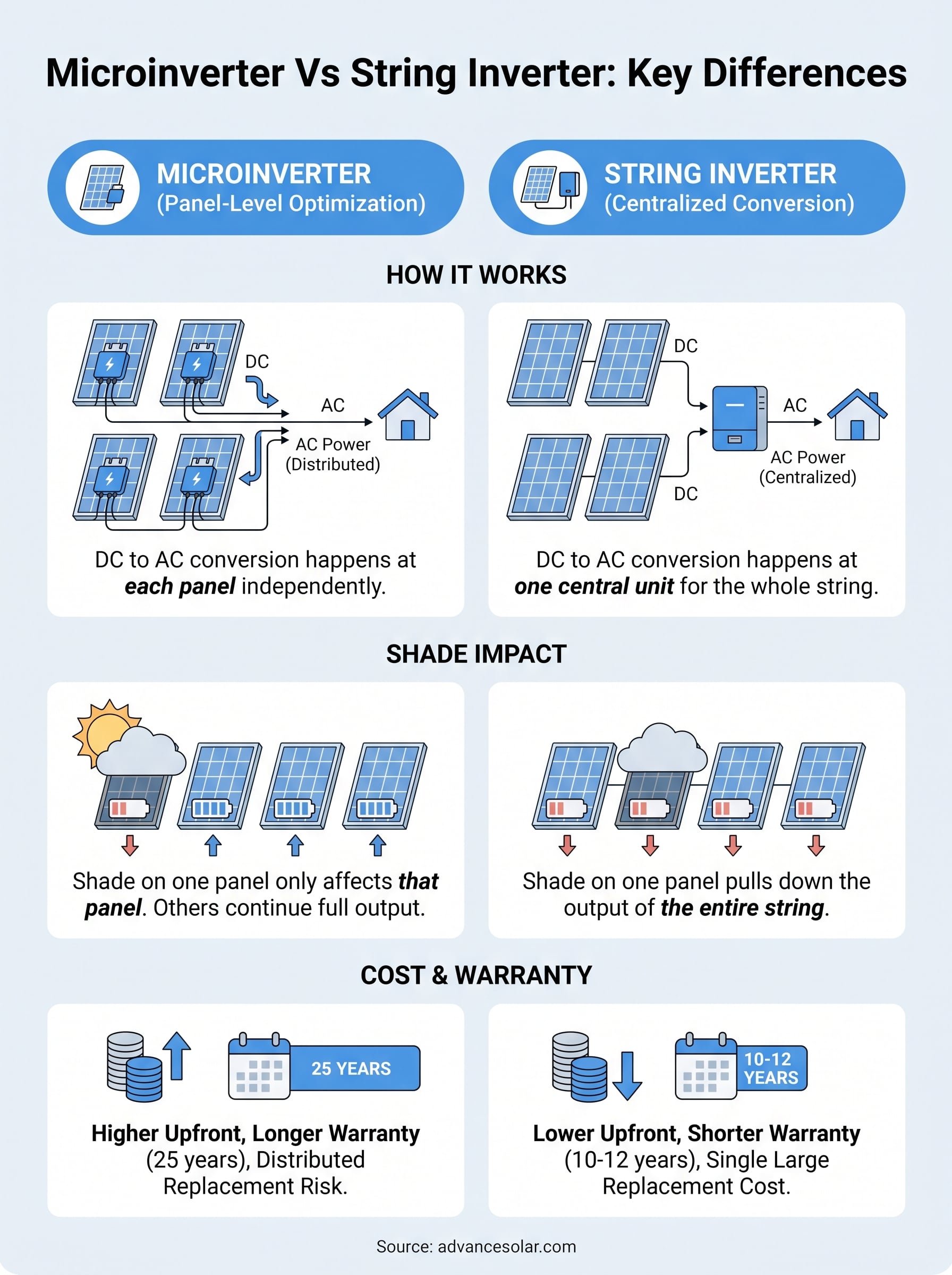
Every solar panel on your roof has its own maximum power point, the ideal operating condition where it produces peak wattage. When you evaluate a microinverter vs string inverter, the core difference is where that optimization happens. String inverters manage all panels together, which means one panel’s underperformance pulls down the output of every panel on that string. Microinverters optimize each panel individually, so a single weak panel stays isolated from the rest.
The way your inverter manages individual panel output is what separates a system that generates full capacity from one that consistently falls short.
What a single point of failure costs you
String inverters introduce a single point of failure into your system. If the inverter fails, your entire array stops producing power until it gets repaired or replaced. In Florida, where heat and humidity accelerate wear on electronics, that risk is real. A string inverter failure mid-summer can leave you fully dependent on grid power during your highest-usage months, which directly hits your utility bill.
Microinverters distribute that risk across every panel. If one unit fails, only that panel stops producing while the rest of the system keeps running. This matters especially on larger rooftops where a total system shutdown carries a much higher production loss.
How inverter type shapes long-term financial risk
Your inverter choice also affects warranty exposure and replacement planning. Standard string inverters carry warranties of 10 to 12 years, while most microinverters come with 25-year warranties that match the expected life of your panels. When a string inverter reaches end of life, you face a single large replacement cost at a time you may not have budgeted for.
Microinverter systems spread that exposure across individual units that can be replaced one at a time, and many go the full 25 years without any failure at all. Over a 30-year ownership horizon, that difference in risk profile can be as significant as the upfront price gap between the two technologies.
How microinverters work and when to pick them
A microinverter mounts directly on each solar panel and converts DC power to AC electricity right at the source. Because each panel operates independently, your system avoids the chain-reaction losses that affect string-based setups. When you compare a microinverter vs string inverter, this panel-level independence is what drives the core performance difference.
The mechanics behind panel-level conversion
Each microinverter runs its own maximum power point tracking (MPPT), which means it continuously adjusts to find the optimal operating point for that one panel regardless of what the others are doing. If a cloud passes over one corner of your roof, only that panel’s output drops while every other panel continues producing at full capacity. Enphase, which Advance Solar & Spa installs as a Platinum Installer, builds this optimization into each unit along with panel-level monitoring through the Enlighten app.
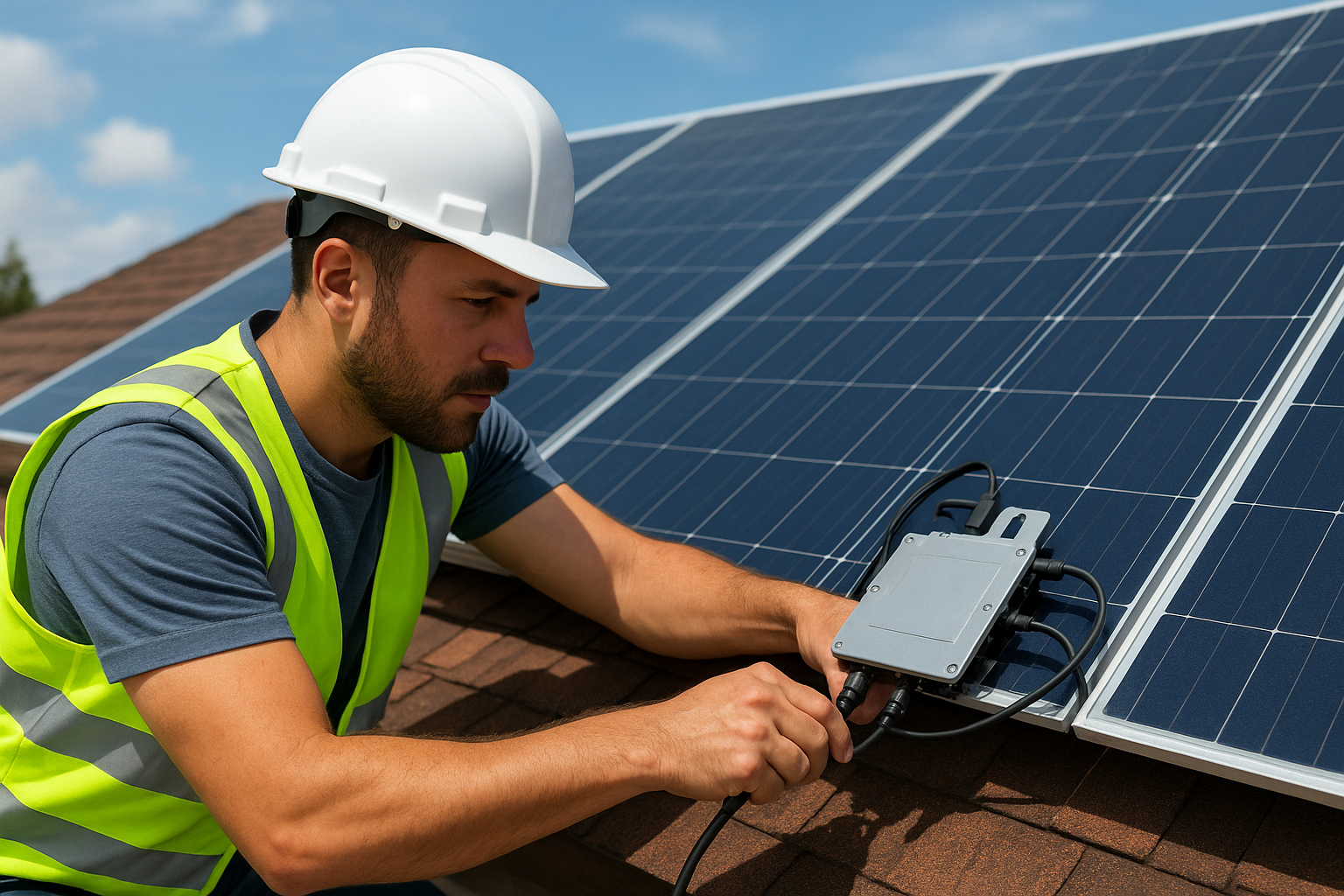
Panel-level monitoring means you can see exactly which panel is underperforming and why, instead of guessing from a single system-wide reading.
When microinverters make the most sense
Microinverters are the stronger choice for complex rooftops with multiple faces, angles, or obstructions that cast shade at different times of day. They also suit homeowners who plan to expand their system in phases, since adding panels is straightforward without worrying about string sizing or compatibility limits.
Pick microinverters if your situation includes any of the following:
- Multiple roof faces or mixed orientations
- Trees, chimneys, or neighboring structures that produce partial shade
- Plans to add panels over time
- A priority on panel-level monitoring and full system transparency
How string inverters work and when to pick them
A string inverter connects a series of solar panels into a circuit called a "string" and converts all of that DC power at one central unit, typically mounted on an exterior wall near your electrical panel. The inverter manages the entire string as a group, which keeps the equipment simple and the installation straightforward. When you compare a microinverter vs string inverter, this centralized approach is what creates both the cost advantage and the performance limitations.
Centralized conversion means fewer components overall, which typically translates to lower upfront installation costs and simpler long-term maintenance for straightforward rooftops.
The mechanics behind centralized conversion
String inverters use a shared maximum power point tracking (MPPT) process across all panels in the string. The inverter finds the best operating point for the group and holds every panel to that same output level. Because the conversion happens in one place rather than at each panel, the hardware is simpler and the unit is easier to service. Manufacturers like Enphase and SolarEdge have improved string inverter technology significantly, but the fundamental group-management structure remains.
When string inverters make the most sense
String inverters work well on unobstructed, south-facing rooftops where all panels receive consistent sunlight throughout the day. Without shade or mixed orientations causing one panel to drag down the rest, the system produces close to its rated output reliably. Pick a string inverter if your situation includes:
- A clean, unshaded roof with panels facing a single direction
- A tight upfront budget where lower equipment cost is a priority
- A straightforward single-story home without complex rooflines
How shade, roof layout, and clipping affect output
Even a small amount of shade can cut what your solar array produces far more than most homeowners expect. Understanding how shade interacts with your inverter type helps you avoid choosing a setup that leaves real production on the table before your system even hits its first summer.
How shade hits string inverters harder
When partial shade falls on even one panel in a string, the entire string drops to match that panel’s reduced output. This is the biggest practical weakness in the microinverter vs string inverter comparison for Florida homeowners with mature trees, chimneys, or nearby structures. A single shaded panel can pull string output down by 30% or more depending on how severe the shading is and when it occurs during peak production hours.
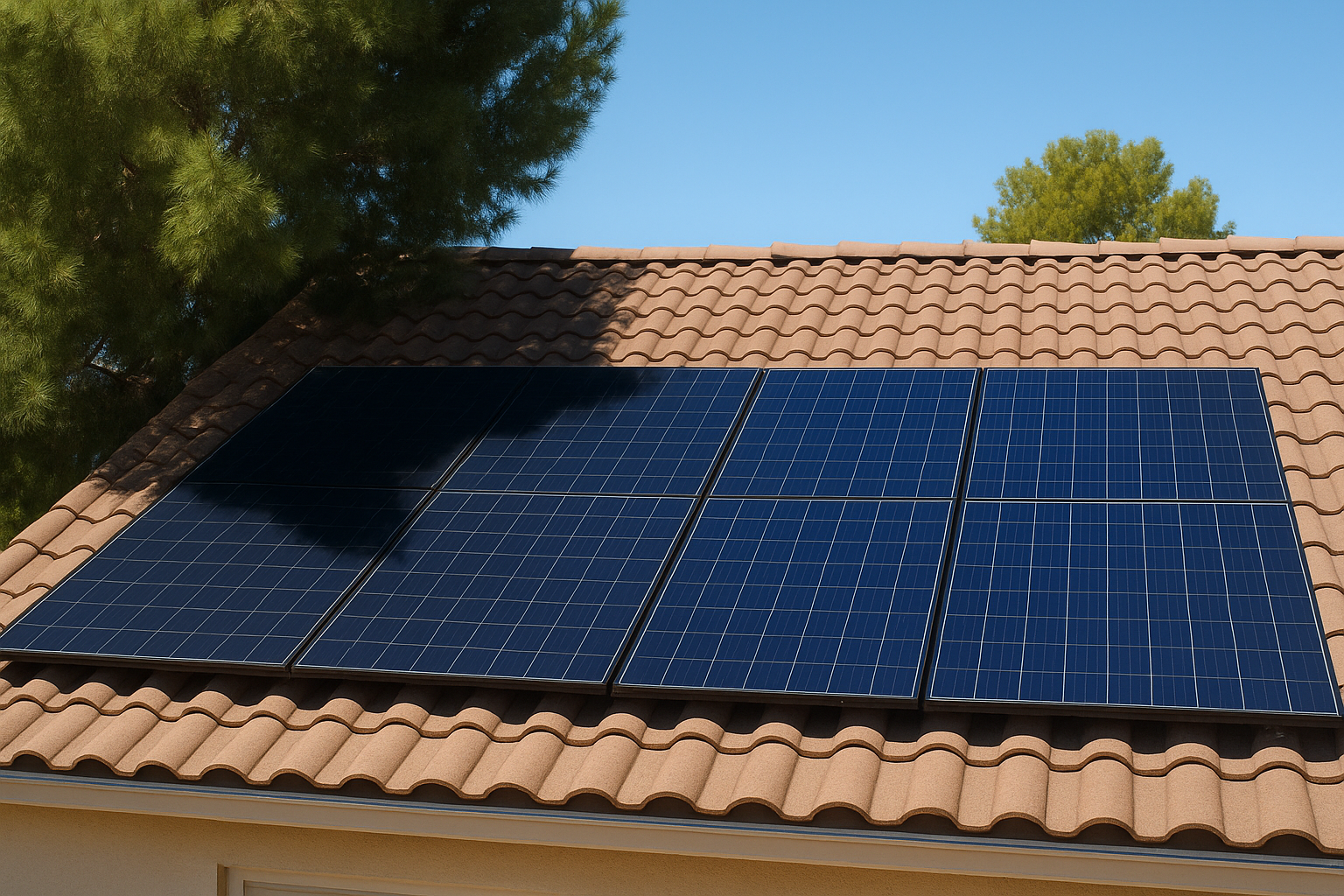
Shade on one panel in a string doesn’t just hurt that panel, it pulls every other panel on that string down to the same reduced output level.
How roof layout creates hidden production losses
Multiple roof faces with different orientations create a similar problem for string inverters. If your roof has panels facing southeast and southwest and you wire them onto the same string, the inverter can only optimize for one direction at a time. Panel-level microinverters solve this because each unit tracks its own maximum output independently, regardless of what neighboring panels are doing.
What clipping means for your system
Clipping happens when your panels produce more power than your inverter can process, and the excess gets cut before it reaches your home. String inverters face higher clipping risk on aggressively sized systems. Properly matched microinverter systems reduce that risk because each unit handles only one panel’s output, keeping conversion within its rated capacity.
How to choose for your home in Florida
Florida’s climate adds specific weight to the microinverter vs string inverter decision. The combination of intense heat, frequent afternoon cloud cover, and hurricane season creates conditions where system resilience and shade tolerance matter more than they might in other states. Before you pick a technology, you need to look at your specific roof, your budget, and how much risk you’re comfortable carrying over the next 25 years.
Florida homeowners face higher inverter stress from heat and humidity than most of the country, which makes warranty length and failure risk a bigger factor in the decision here than elsewhere.
Consider your roof conditions first
Walk around your property and note any shade sources: mature trees, a chimney, a neighboring structure, or even a satellite dish. If you have shade hitting your roof at any point between 9am and 4pm, microinverters will protect your production in ways a standard string inverter simply cannot. The same applies if your roof has multiple faces pointing in different directions, which is common on Florida homes with hip roofs.
Factor in your budget and timeline
If your roof is clean, unshaded, and faces a consistent direction, a string inverter gives you solid performance at a lower upfront cost. That savings can be meaningful if you’re working within a tight budget. On the other hand, if you plan to stay in your home for 20-plus years and want the longer warranty coverage and panel-level monitoring, microinverters reduce the long-term financial surprises. Your energy goals, roof geometry, and ownership timeline should drive the final call.
Final takeaway
The microinverter vs string inverter decision comes down to your specific roof, your budget, and how long you plan to own the system. If your roof is clean, unshaded, and faces one direction, a string inverter delivers reliable output at a lower upfront cost. If you have shade, multiple roof faces, or a long ownership horizon, microinverters protect your production and spread your long-term risk across individual units rather than one central component.
Florida’s heat, humidity, and afternoon cloud cover make inverter resilience and warranty length more important here than in most states. Neither technology is universally better, but the right choice for your home becomes clear once you look honestly at your roof conditions and your energy goals. Advance Solar & Spa has been helping Florida homeowners make this call for over 40 years. Get a free solar assessment from our team and find out which inverter fits your home.