What Size Off Grid Solar System Do I Need? Sizing Guide
-
Share
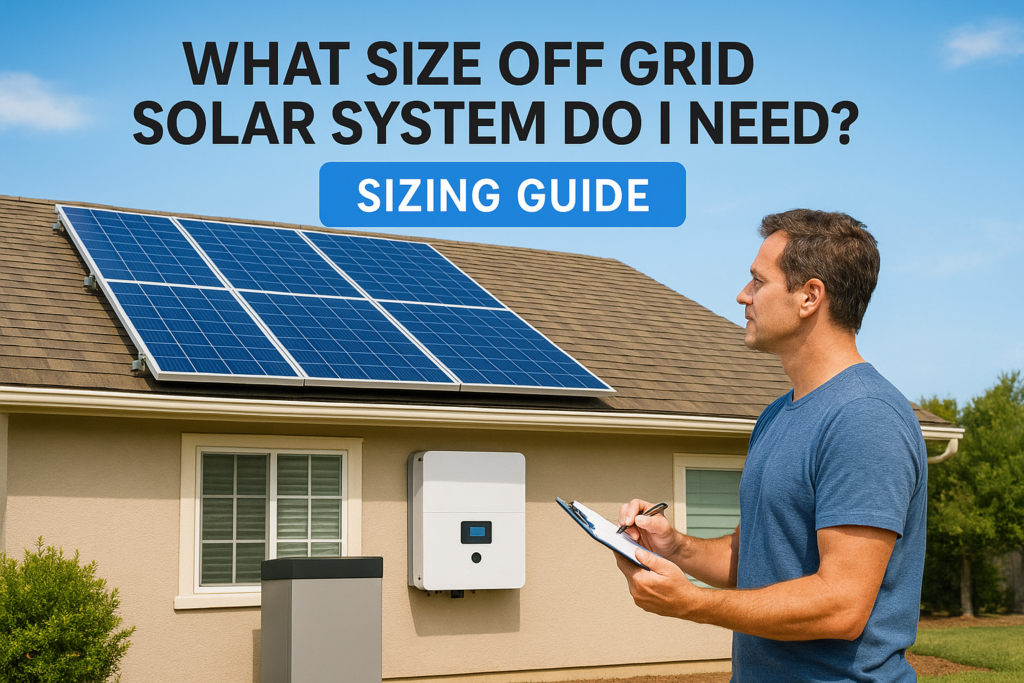
Getting the answer to “what size off grid solar system do I need” starts with understanding your own energy use, not with picking panels off a shelf. Every home and every lifestyle draws power differently, and an undersized system leaves you in the dark while an oversized one wastes thousands of dollars. The math matters, and it’s more straightforward than most people expect.
At Advance Solar & Spa, we’ve designed and installed over 50,000 solar energy systems across Florida since 1983. Our in-house engineering team sizes systems every day, grid-tied and off-grid alike, so we know exactly where people get tripped up in the process. We built this guide to walk you through each step of the calculation, from adding up your daily kilowatt-hour usage to choosing the right battery bank and inverter for your specific situation.
Below, you’ll find a clear, step-by-step method to calculate your solar panel wattage, battery storage capacity, and inverter size based on your actual consumption and local sun hours. No guesswork, no generic recommendations, just a practical framework you can apply to your own off-grid project right now.
What to know before you size an off-grid system
Before you answer “what size off grid solar system do I need,” you need to understand three core inputs: how much energy you consume daily, how many peak sun hours your location receives, and how many days of backup you want without sunlight. Skipping any of these produces a system that either falls short or costs far more than necessary.
Three variables drive every sizing decision
Your daily energy consumption in kilowatt-hours (kWh) is the foundation of the entire calculation. Your peak sun hours tell you how much energy each panel can realistically produce per day, and your autonomy days (the number of cloudy days your battery bank must cover) determine your storage size. All three numbers interact, so changing one changes the others.
Getting one variable wrong can result in a system that fails on day three of a cloudy week or costs 40% more than it needs to.
Use this table as a quick reference for how these variables connect before you start calculating:
| Variable | What it determines | Example value |
|---|---|---|
| Daily kWh usage | Total energy the system must replace | 20 kWh/day |
| Peak sun hours | Realistic panel output per day | 5 hours (central Florida) |
| Autonomy days | Minimum battery bank size | 2 to 3 days |
Why off-grid sizing is stricter than grid-tied
Grid-tied systems can draw on utility power when solar production dips, but off-grid systems carry the full load entirely on their own. That means you size for your worst-case scenario, not your average day. In Florida, that worst case is typically a stretch of overcast weather during the rainy season, roughly June through September, when cloud cover consistently reduces solar output and your battery bank takes on the heaviest workload of the year.
Step 1. List your loads and daily kWh
Your first task is to add up every appliance and device you plan to run off the system and calculate how many kilowatt-hours that total equals per day. This single number drives the rest of your sizing decisions for answering what size off grid solar system do I need, so accuracy here saves money and prevents serious shortfalls later.
Build a load inventory
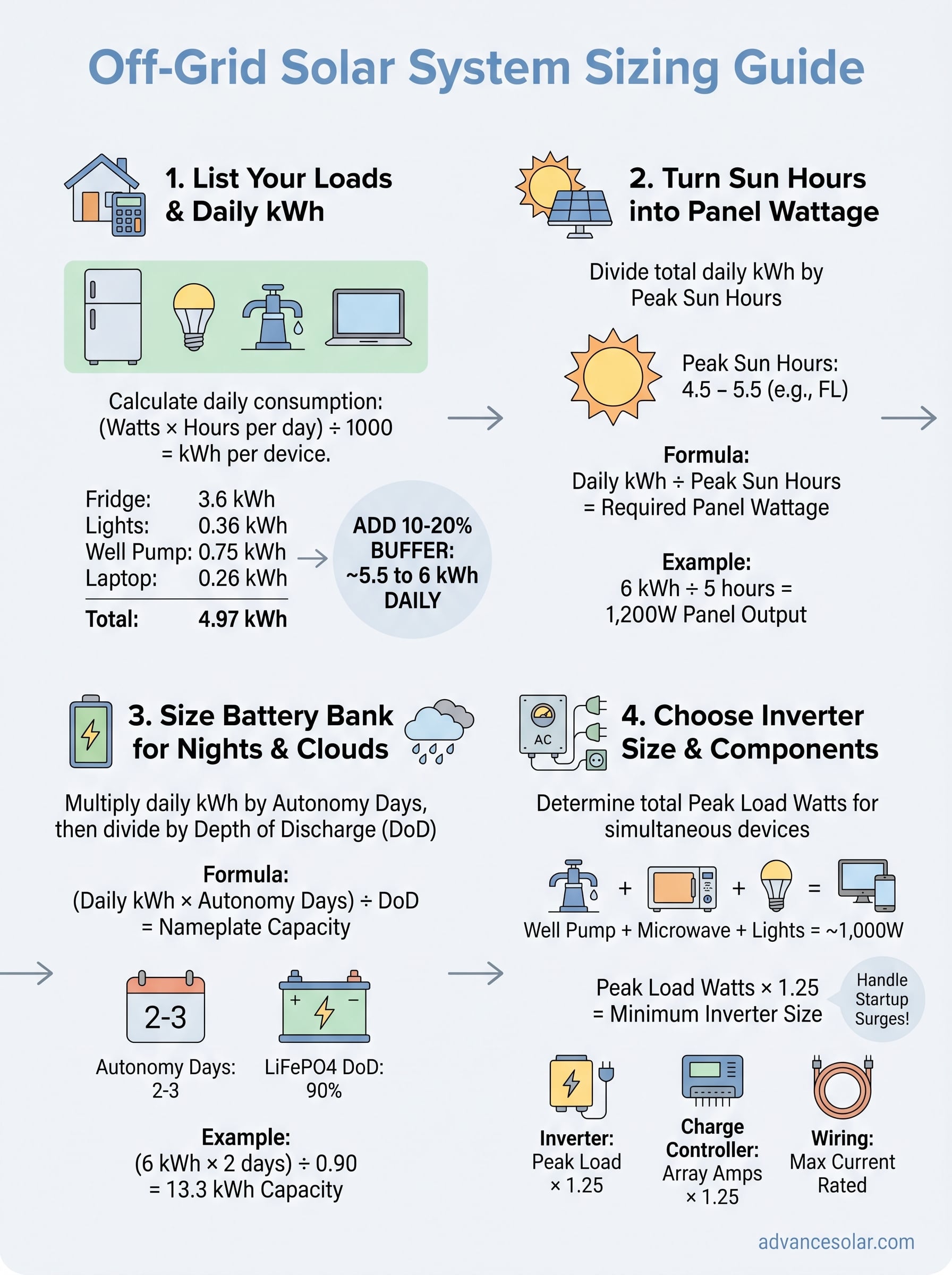
Start by listing each appliance, its wattage rating (found on the label or in the owner’s manual), and how many hours per day you plan to run it. Multiply watts by daily hours to get watt-hours, then divide by 1,000 to convert to kWh. Add every line together to get your total daily consumption figure.
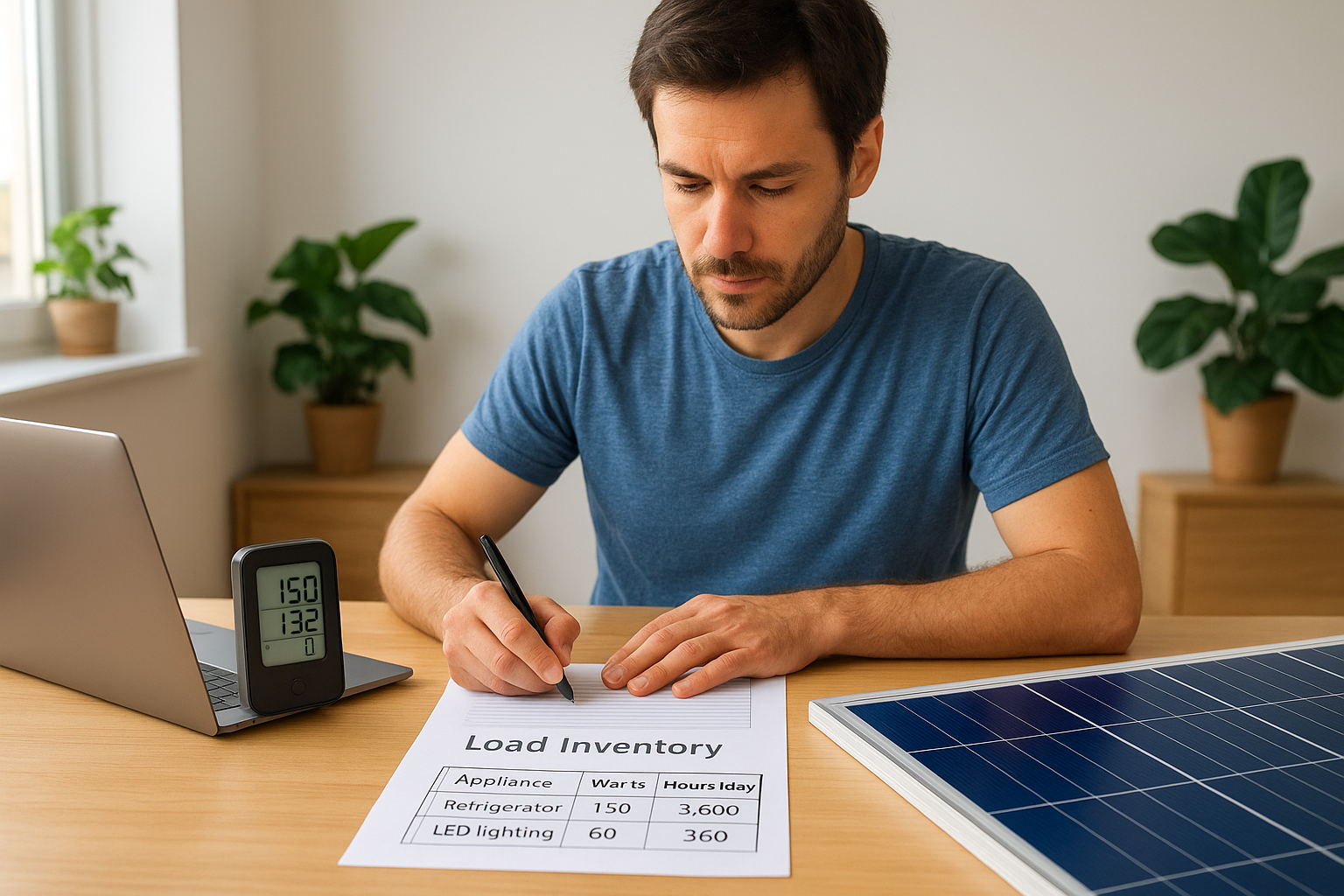
If you’re uncertain about an appliance’s wattage, a plug-in energy monitor gives you a real measurement in minutes.
Use this template to organize your inventory:
| Appliance | Watts | Hours/day | Watt-hours/day |
|---|---|---|---|
| Refrigerator | 150 | 24 | 3,600 |
| LED lighting | 60 | 6 | 360 |
| Well pump | 750 | 1 | 750 |
| Laptop | 65 | 4 | 260 |
| Total | 4,970 Wh = 4.97 kWh |
Add a 10 to 20% buffer on top of your total to account for real-world losses in wiring, inverters, and battery charging cycles. A home drawing 5 kWh per day actually needs your system to produce roughly 5.5 to 6 kWh daily to keep everything running reliably.
Step 2. Turn sun hours into panel wattage
Once you have your adjusted daily kWh figure, you can calculate how many watts of solar panels you need. The formula is straightforward: divide your daily energy requirement by your local peak sun hours to get your minimum panel wattage.
Find your peak sun hours
Peak sun hours measure the hours per day when sunlight intensity reaches 1,000 watts per square meter, the standard used to rate solar panel output. In Florida, most locations receive between 4.5 and 5.5 peak sun hours per day, with southern Florida averaging closer to 5.5 and the Panhandle closer to 4.5.
Use the lower end of your local range to build in a safety margin that keeps your system reliable on below-average days.
Apply the panel wattage formula
Divide your adjusted daily kWh by your peak sun hours figure to get the minimum system wattage you need. Use this template:
| Input | Example value |
|---|---|
| Adjusted daily kWh | 6 kWh |
| Peak sun hours | 5 hours |
| Required panel wattage | 1,200W |
Knowing what size off grid solar system do I need comes down to rounding this number up to the next available panel configuration, never down. A 1,200W requirement typically translates to six 200W panels or four 300W panels, depending on what fits your roof or ground mount.
Step 3. Size your battery bank for nights and clouds
Your battery bank covers the energy you consume when the sun isn’t producing, which means overnight hours and consecutive cloudy days. To size it correctly, multiply your adjusted daily kWh by the number of autonomy days you want, then divide by your battery’s depth of discharge (DoD) to find the actual nameplate capacity you need to buy.
Calculate your storage requirement
Divide your total energy requirement by your battery’s DoD rating to get the minimum nameplate capacity you need to purchase. Most lithium iron phosphate (LiFePO4) batteries, including Tesla Powerwall and Enphase IQ Battery units, allow 80 to 90% DoD, which makes them far more efficient than older lead-acid options that typically cap at 50%.
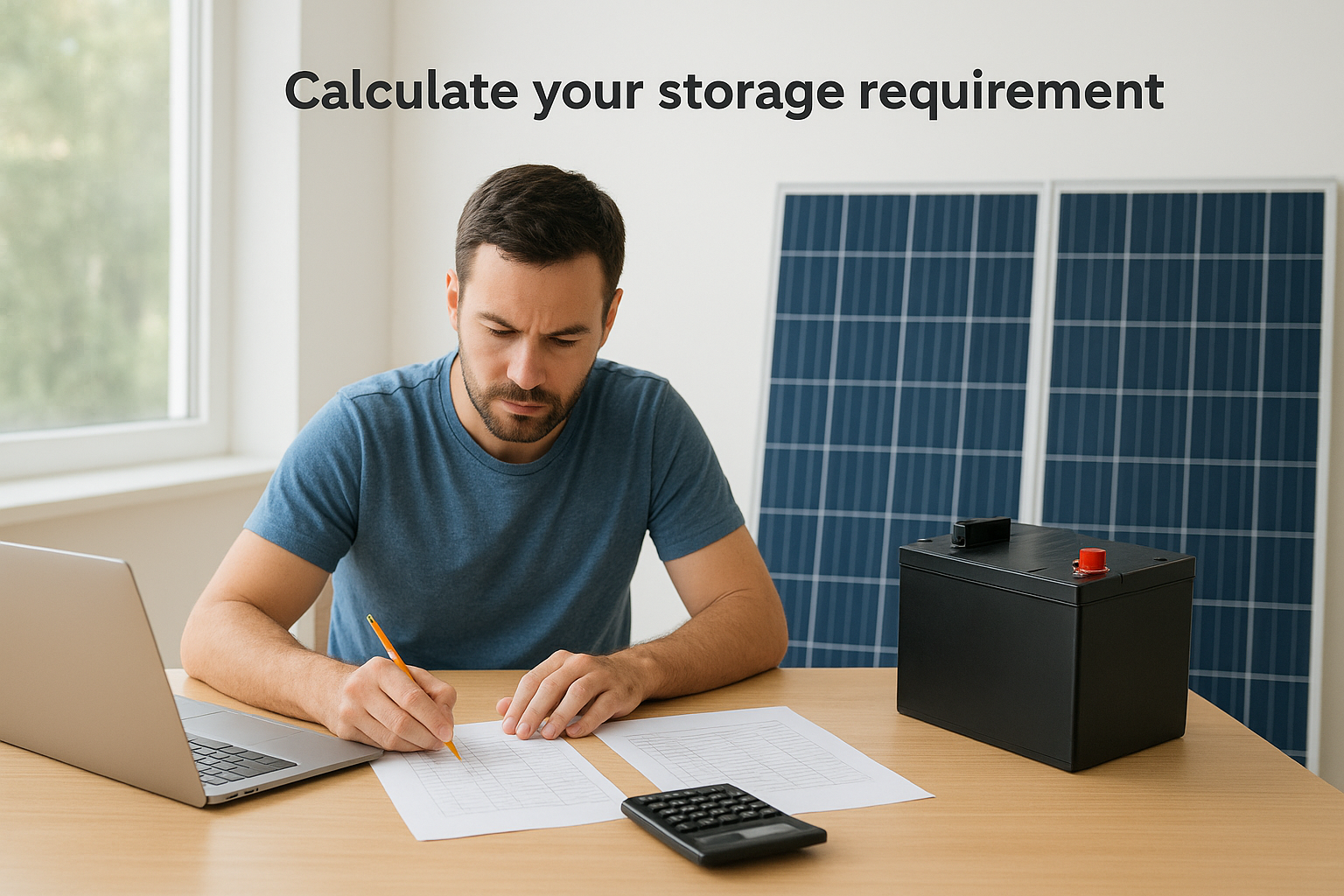
Sizing your battery bank for at least 2 autonomy days protects you during Florida’s rainy season when cloud cover can stretch across multiple consecutive days.
Use this template to run your own numbers:
| Input | Example value |
|---|---|
| Adjusted daily kWh | 6 kWh |
| Autonomy days | 2 |
| Total storage needed | 12 kWh |
| Battery DoD | 90% |
| Required nameplate capacity | 13.3 kWh |
Answering what size off grid solar system do I need means choosing the right battery chemistry from the start, since DoD directly determines how much capacity you actually get to use and how long your bank lasts over hundreds of charge cycles.
Step 4. Choose inverter size and key components
Your inverter converts DC power from your panels and batteries into the AC power your appliances use. To size it correctly, identify the peak wattage of all loads you might run simultaneously, not your average draw. An undersized inverter will trip or fail the moment you run two high-demand appliances at once.
Match your inverter to peak load
Add up the wattage of every appliance you could run at the same time during peak demand. A refrigerator, well pump, and lights running together might hit 1,000W simultaneously, but if you start the well pump while the microwave runs, you could spike to 2,000W or more. Always buy an inverter rated 25 to 30% above your calculated peak load to handle startup surges.
Motor-driven appliances like pumps and air conditioners draw two to three times their running wattage at startup, so your inverter must handle that surge without shutting down.
Use this reference when selecting core components for what size off grid solar system do I need:
| Component | How to size it |
|---|---|
| Inverter | Peak load watts x 1.25 |
| Charge controller | Panel array amps x 1.25 |
| Wiring | Rated for max system current |
A simple wrap-up
Figuring out what size off grid solar system do I need comes down to four numbers: your daily kWh load, your local peak sun hours, your battery autonomy days, and your peak inverter load. Work through each step in order and you build a system that covers your actual usage instead of someone else’s estimate. Add your buffers at every stage, size up rather than down, and choose lithium chemistry batteries to maximize the storage capacity you actually get to use.
Every sizing decision you make compounds into the next one, so starting with an accurate load inventory is the most important thing you can do before buying a single component. Florida’s sun is a real advantage, but the rainy season still demands a properly sized battery bank.
If you want a certified engineer to run these numbers for your specific property and location, contact the team at Advance Solar & Spa and get a professional assessment.