
Dirty solar panels can lose 15% to 25% of their energy output, which means you’re paying more on your electricity bill for power your system should already be generating. So when you start searching for the solar panel cleaning price to fix that, you’ll find quotes all over the map, some companies charge per panel, others by system size, and a few offer flat rates that may or may not include everything.
At Advance Solar & Spa, we’ve installed and maintained over 50,000 solar systems across Florida since 1983. Our service team handles panel cleaning alongside repairs and inspections every week, so we see firsthand what homeowners actually pay, and what they should expect. That experience gives us a clear picture of fair market pricing versus inflated quotes.
This article breaks down the average cost of professional solar panel cleaning in 2026, including per-panel rates, flat-rate pricing, and the factors that push costs higher or lower. We’ll also cover when it makes sense to hire a professional versus doing it yourself, so you can make a decision that actually protects your investment.
Why solar panel cleaning prices vary
The solar panel cleaning price you receive from a contractor depends on several factors, not just how many panels sit on your roof. Contractors look at access conditions, soiling levels, and local market rates before they set a number, which is why two homes with the same system size can get very different quotes. Understanding what drives that price helps you evaluate a bid before you agree to it.
Panel count and system size
The most direct driver of your cleaning cost is how many panels your system includes. Most companies price per panel, with rates that typically drop on a per-unit basis as the system gets larger. A 10-panel system costs more per panel to clean than a 30-panel system because the setup time, travel, and equipment costs are spread across fewer units. When you request a quote, always confirm whether the rate is per panel or a flat fee for the full job, since some companies bundle both into a single number without making that clear upfront.
Roof type and accessibility
How easy it is to reach your panels matters just as much as how many you have. A single-story home with a low-pitch roof is far cheaper to service than a two-story house with a steep metal or tile roof. Contractors factor in the time and safety equipment their crew needs to work at height, so anything that slows them down adds to your total. Ground-mounted systems are usually the least expensive to clean because there is no roof work involved at all.
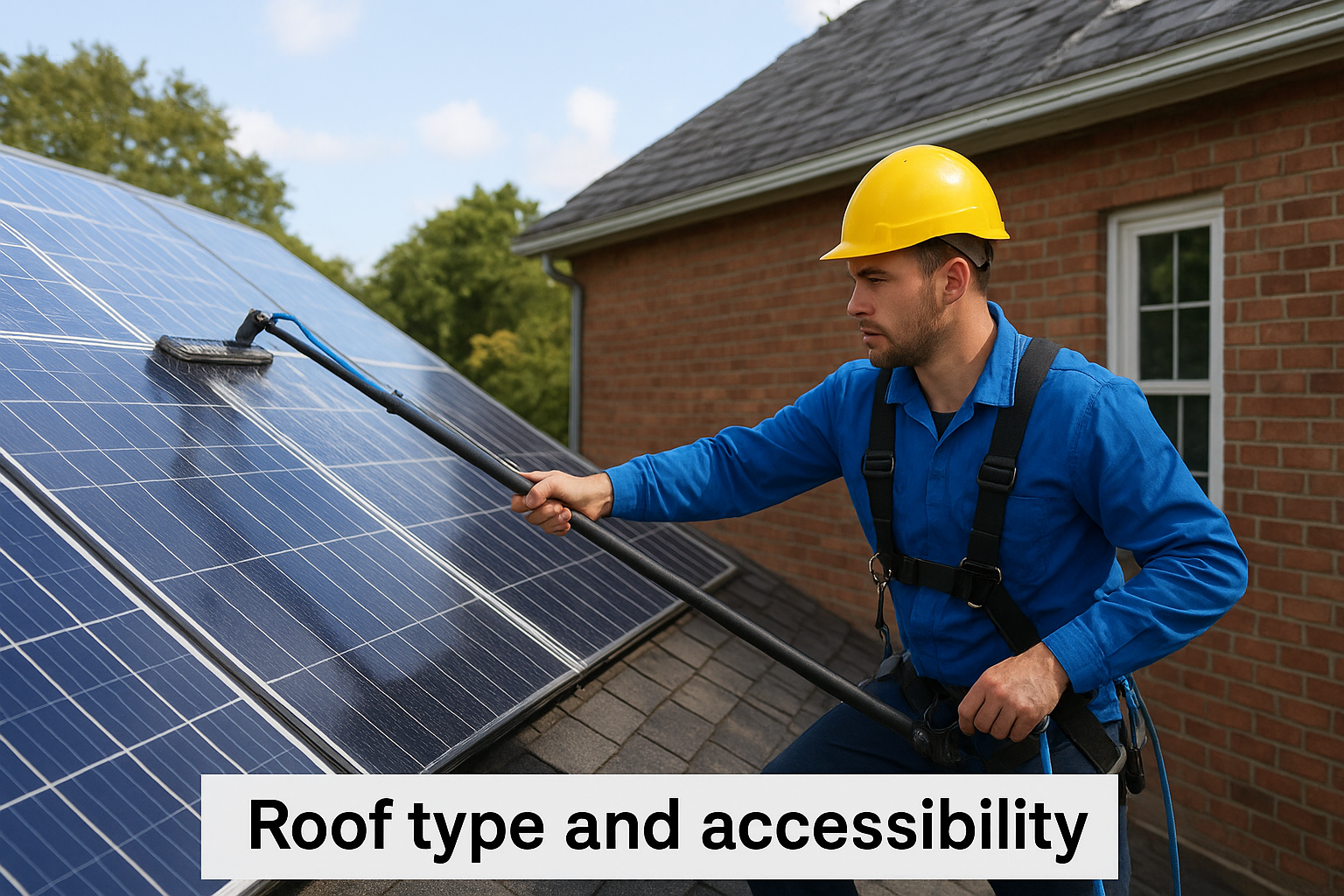
If your roof requires specialized safety rigging or ladder extensions, expect to pay a premium of 20% to 40% above the standard rate for that added complexity.
Soiling level and cleaning frequency
Panels that haven’t been touched in two or three years take longer to clean than panels on a regular maintenance schedule. Heavy buildup from bird droppings, pollen, or hard water mineral deposits often requires more water pressure, specialized cleaning solutions, or additional labor time to remove properly. Panels located in heavily wooded areas or near construction activity accumulate debris faster and may need more frequent visits throughout the year. Sticking to a consistent cleaning schedule is one of the most practical ways to keep your per-visit cost lower over the long run.
Location and local market rates
Where you live affects what contractors charge, independent of the actual work involved. Labor costs in Florida’s coastal markets, like Naples, Fort Lauderdale, and Sarasota, tend to run higher than in inland areas because business operating expenses are higher there overall. Seasonal demand also pushes prices up in predictable ways. After heavy pollen season in spring or following hurricane debris events, cleaning services book up quickly and some companies adjust their pricing accordingly. Requesting quotes during slower periods, when demand is lower, can sometimes save you 10% to 15% compared to the peak windows when every solar homeowner in your area is calling at once.
Average solar panel cleaning prices in 2026
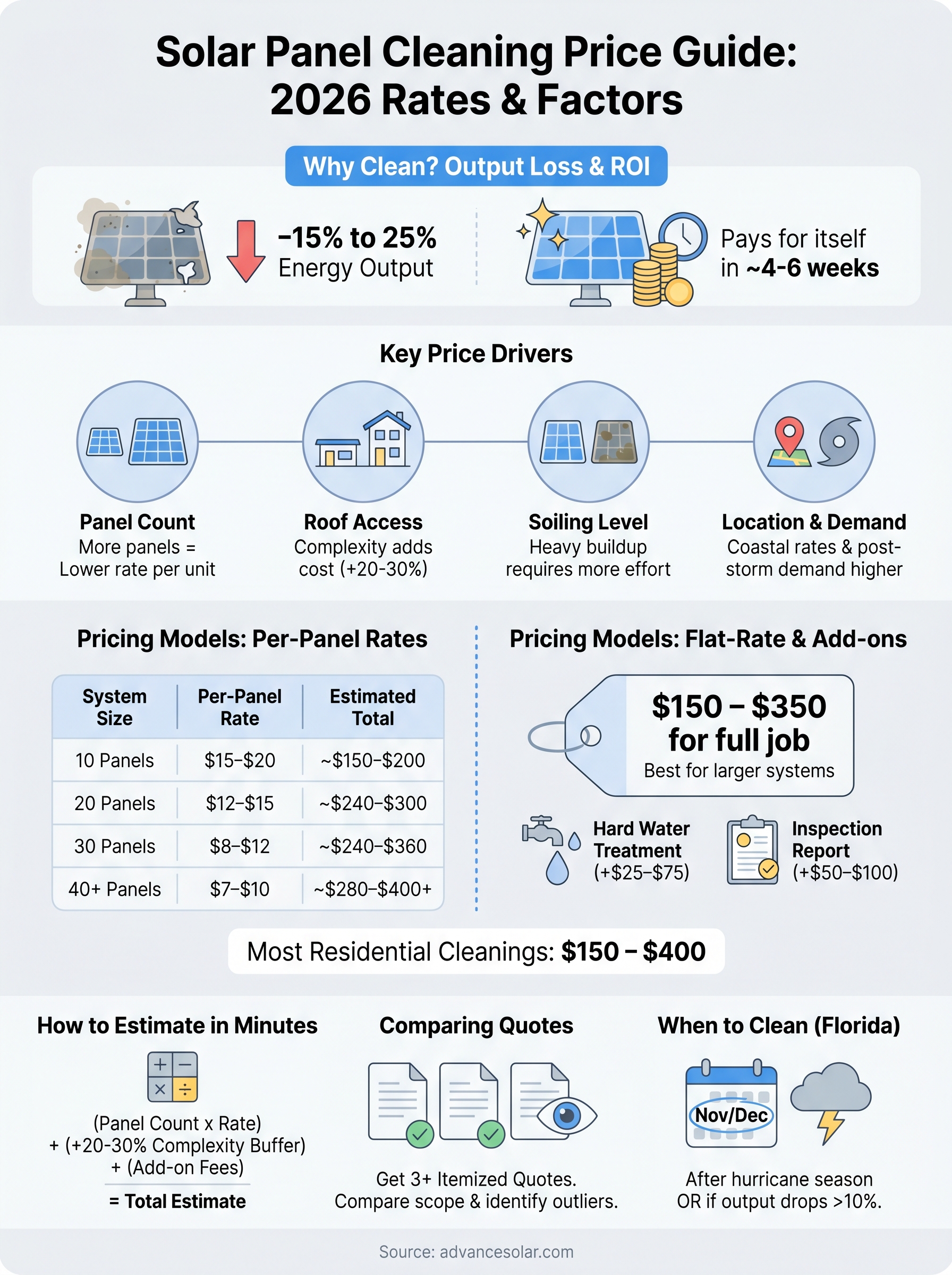
Pricing for professional solar panel cleaning has settled into two main structures in 2026: per-panel rates and flat-rate fees. Most residential homeowners in Florida pay somewhere between $150 and $400 for a full cleaning, depending on system size, roof access, and local labor costs. Knowing the typical ranges for each pricing model helps you spot a fair quote and walk away from an inflated one.
Per-panel rates
Most contractors quote a per-panel rate that falls between $8 and $20 for a standard residential system. Smaller systems with 10 to 15 panels sit at the higher end of that range, while larger systems spread the per-unit cost down toward $8 to $12 per panel. The table below gives you a practical baseline for what to expect based on your system size.
| System Size | Per-Panel Rate | Estimated Total |
|---|---|---|
| 10 panels | $15 – $20 | $150 – $200 |
| 20 panels | $12 – $15 | $240 – $300 |
| 30 panels | $8 – $12 | $240 – $360 |
| 40+ panels | $7 – $10 | $280 – $400+ |
Flat-rate pricing
Some companies skip per-panel billing entirely and charge a single flat rate for the full job, typically ranging from $150 to $350 for a standard residential system. Flat-rate pricing works in your favor when you have a larger system, since the total cost stays fixed regardless of panel count. On a smaller 10-panel setup, per-panel pricing usually comes out cheaper, so it pays to run both calculations before you commit.
Always confirm whether the quoted price covers roof access, water supply, and all labor, or whether those are billed as separate line items.
Additional service fees
Beyond the base solar panel cleaning price, contractors sometimes add charges for services outside a standard visit. Hard water treatment to remove mineral deposits, which is common in Florida coastal areas, typically adds $25 to $75. Written inspection reports can add another $50 to $100. Asking for a full itemized quote upfront is the simplest way to avoid surprises when the invoice arrives.
How to estimate your cleaning cost in minutes
You don’t need to wait for a contractor callback just to get a ballpark solar panel cleaning price for your home. A quick estimate takes under five minutes if you know two things: how many panels you have and which pricing model the contractor uses. Start with those inputs, and you’ll walk into any quote conversation already knowing what a reasonable number looks like.
Start with your panel count
Check your original installation paperwork or your system monitoring app to confirm your exact panel count. Most residential systems in Florida run between 20 and 30 panels, which puts the typical cleaning estimate somewhere between $240 and $360 using per-panel rates. If you can’t locate your paperwork, your inverter’s monitoring dashboard, whether it’s Enphase Enlighten or the Tesla app, will display system size in kilowatts. A reliable rule of thumb is three panels per kilowatt of system capacity, so a 10 kW system gives you roughly 30 panels to work with.
If your monitoring app shows a 10 kW system, expect around 30 panels and a base cleaning estimate in the $240 to $360 range before any add-on fees.
Apply the right rate to your situation
Once you have your panel count, multiply it by the per-panel rate that fits your system size: $15 to $20 for systems under 15 panels, $12 to $15 for mid-size systems, and $8 to $12 for larger setups above 25 panels. Then factor in conditions that push your cost higher, such as a steep tile roof, heavy debris buildup from nearby trees, or the hard water mineral deposits common in Florida coastal areas. A 20% to 30% buffer on top of the base estimate covers most of those scenarios without overcomplicating the math.
Build your estimate using this simple framework
Running the numbers takes about two minutes once you have the inputs ready. Work through these three steps in order:
- Panel count x per-panel rate = base estimate
- Base estimate + 20% to 30% for access or soiling complexity = adjusted estimate
- Adjusted estimate + add-on fees (hard water treatment, inspection report) = your realistic total
How to compare quotes and avoid overpaying
Getting multiple quotes is the single most effective way to avoid overpaying on your solar panel cleaning price. Most homeowners call one or two companies, accept the first reasonable-sounding number, and move on. That approach works, but requesting at least three itemized quotes gives you a realistic picture of what your local market actually charges and makes inflated bids obvious by comparison. When you have three numbers side by side, outliers become easy to spot.
Ask for itemized pricing, not just a total
When a contractor sends you a quote, a single lump sum tells you very little about what you’re actually paying for. Ask them to break it down into base cleaning cost, any access fees for roof complexity, and add-on services like hard water treatment or an inspection report. That breakdown lets you compare quotes on equal terms because you’re comparing the same line items rather than two different bundles of services wrapped in different price tags.
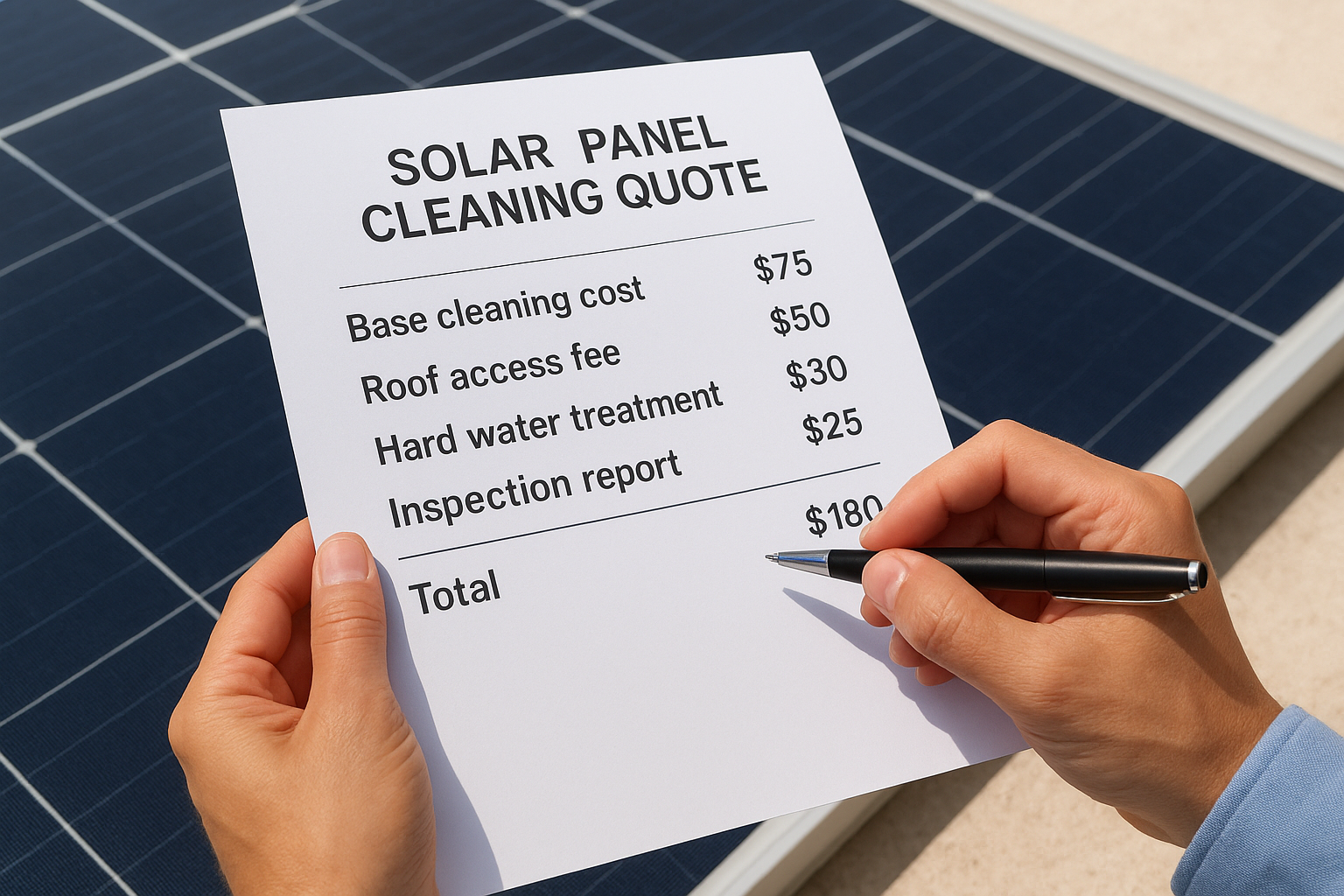
If a contractor refuses to provide an itemized breakdown, treat that as a red flag and move on to the next option.
Here’s a simple checklist to run through when you review each quote:
- Base cleaning cost (per-panel or flat rate)
- Roof access or complexity fee
- Hard water or mineral deposit treatment
- Inspection or written report fee
- Travel or trip charge if applicable
Watch for scope gaps between quotes
Not every quote covers the same scope of work, which is the most common reason two bids look wildly different. One company might include a post-cleaning inspection and water spot treatment in their standard rate, while another strips those out to show a lower headline number. Before you assume the cheaper quote saves you money, confirm exactly what each company includes and what they’ll charge extra for after the job is done. A quote that looks $80 cheaper upfront can easily cost more once add-ons appear on the final invoice, so read every line before you sign.
When professional cleaning makes sense in Florida
Florida’s climate is harder on solar panels than most homeowners realize. High humidity, heavy pollen seasons, and frequent tropical storms create conditions that cause panel performance to drop faster than in drier climates. Knowing when to call in a professional, rather than attempting a DIY rinse, protects both your panels and your energy production numbers.
After hurricane season and storm events
Florida’s hurricane season runs from June through November, and storm debris, salt spray, and wind-blown grime settle onto panels in ways that a light rain shower won’t wash off. After any significant storm event, the combination of organic material and mineral residue bonds to the glass surface and reduces light absorption. A professional crew has the right deionized water equipment and soft-bristle tools to remove that buildup safely without scratching the anti-reflective coating that makes your panels efficient in the first place.
Attempting to pressure wash panels after a storm is one of the fastest ways to void your manufacturer warranty, so leave post-storm cleaning to a licensed technician.
Coastal homeowners in Fort Myers, Naples, and Fort Lauderdale face the added challenge of salt air, which leaves a thin mineral film on panel surfaces over time. That film doesn’t look like much, but it compounds with pollen and dust to form a layer that noticeably cuts output. Scheduling a professional cleaning in November or December, once hurricane season ends, is one of the most cost-effective timing decisions you can make.
When output drops but your system checks out
If your monitoring app shows a consistent output drop of 10% or more and your inverter diagnostics aren’t flagging any equipment faults, dirty panels are the most likely cause. This is the clearest signal that a professional cleaning will deliver a measurable return on whatever you spend. Rather than letting the performance gap compound over months, evaluating the solar panel cleaning price against your actual energy loss in kilowatt-hours makes the decision straightforward. Most Florida homeowners recover the cleaning cost in energy savings within four to six weeks.
Bottom line on solar panel cleaning costs
Professional solar panel cleaning in 2026 costs $8 to $20 per panel, with most Florida homeowners paying between $150 and $400 for a full residential system. That range shifts based on your panel count, roof complexity, soiling level, and local market rates. Knowing those variables before you request quotes puts you in a position to evaluate bids accurately rather than accepting the first number that sounds reasonable.
The solar panel cleaning price is almost always worth it when your output has dropped and your equipment checks out. Panels running at 15% to 25% below capacity cost you real money every month, and a single professional cleaning typically pays for itself within weeks. If you’re ready to schedule a cleaning or want a professional assessment of your system’s condition, contact the Advance Solar & Spa team for straightforward service from a licensed Florida installer with over 40 years of experience.