
If you own a pool in Florida, you already know that heating it with gas or electric can get expensive fast. A solar pool heater uses energy from the sun, which we have plenty of, to raise your pool’s water temperature without spiking your utility bill. It’s one of the most cost-effective ways to extend your swim season year-round, and the technology behind it is simpler than most people expect.
But how exactly does a solar pool heater work? What does installation actually cost, and how much can you realistically save? These are the questions worth answering before you commit to any pool heating system. The upfront numbers, the long-term payoff, and the pros and cons all matter, and they look different depending on your pool size, roof orientation, and how often you swim.
At Advance Solar & Spa, we’ve been designing and installing solar pool heating systems across Florida since 1983, more than 50,000 installations and counting. This article breaks down everything you need to know: how the technology works, what it costs, what kind of savings to expect, and whether it’s the right fit for your pool.
Why solar pool heating matters for pool owners
Florida gives you the sun, but your pool heating bill can still eat into your budget if you’re relying on gas or electric systems. Understanding what is a solar pool heater and why it outperforms traditional heating options helps you make a smarter decision about your pool setup. The difference between heating methods isn’t just about upfront cost; it’s about what you pay every single month, for as long as you own the pool.
The real cost of gas and electric pool heaters
Gas heaters warm your pool fast, but you pay for that speed every time you run them. Monthly operating costs for a gas pool heater can run $200 to $400 or more during cooler months, depending on your pool size and local propane or natural gas rates. Electric heat pumps are more efficient than gas, but they still add $50 to $150 per month to your electricity bill, and in Florida, where summer utility rates are already high, that number compounds quickly across a full swim season.
Most Florida pool owners who switch to solar report cutting their pool heating costs by 80 to 90 percent compared to what they paid with gas or electric systems.
Those savings aren’t a one-time benefit. Once your solar pool heating system is installed and running, the sun does the work at no ongoing fuel cost to you, and that stays true for the 15 to 20-year lifespan of the system.
What solar pool heating changes for your home
Solar pool heaters remove the monthly operating cost almost entirely. Your existing pool pump circulates water through solar collectors mounted on your roof, the sun heats it, and the warm water returns directly to your pool. You’re using energy you were never paying for in the first place, which fundamentally changes the economics of pool ownership.
Florida’s climate makes solar heating especially practical for year-round use. With over 230 sunny days per year statewide, your solar collectors get consistent exposure well beyond the traditional swim season. For homeowners in Fort Myers, Naples, Sarasota, or Fort Lauderdale, a properly sized system can maintain a comfortable pool temperature for most of the year without any backup heating source. You get a longer swim season, a noticeably lower utility bill, and a system that typically pays for itself within three to seven years of installation.
How a solar pool heater works
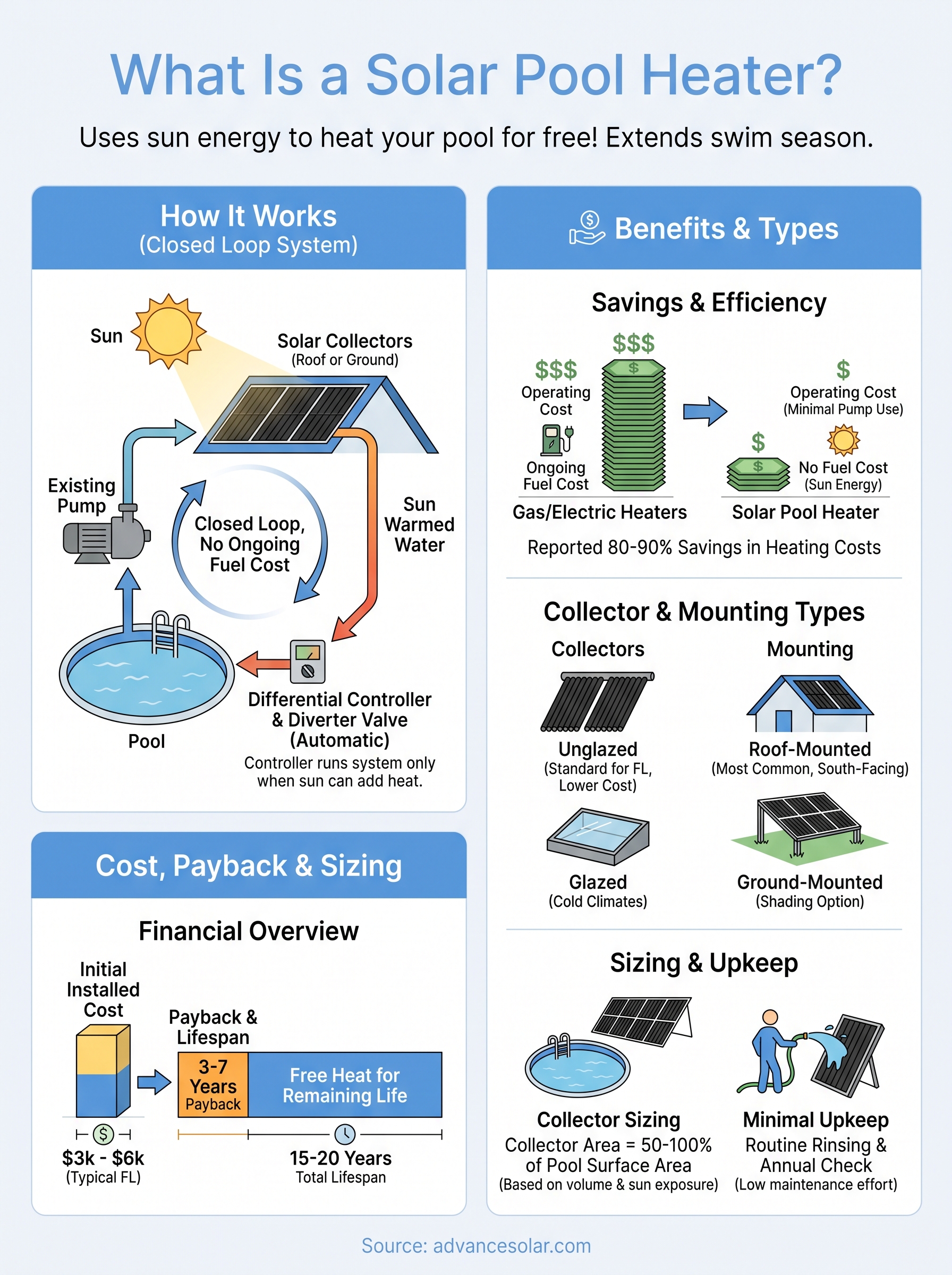
A solar pool heating system works by routing your pool water through a closed loop that passes through sun-warmed collectors. Your existing pool pump does the heavy lifting, pushing water up to the collectors, through the heating panels, and back down into the pool continuously. No separate pump, no complex fuel source, and no major changes to your existing pool equipment.
The heating loop explained
Water leaves your pool through the standard filtration system, travels up to the solar collectors mounted on your roof or ground rack, absorbs heat from the sun as it passes through the collector tubes, and then returns to the pool several degrees warmer. This loop runs automatically whenever the collectors are hot enough to add meaningful heat to your water. A differential controller monitors the temperature difference between the collectors and the pool, and it activates the diverter valve only when running the system actually raises your pool temperature.
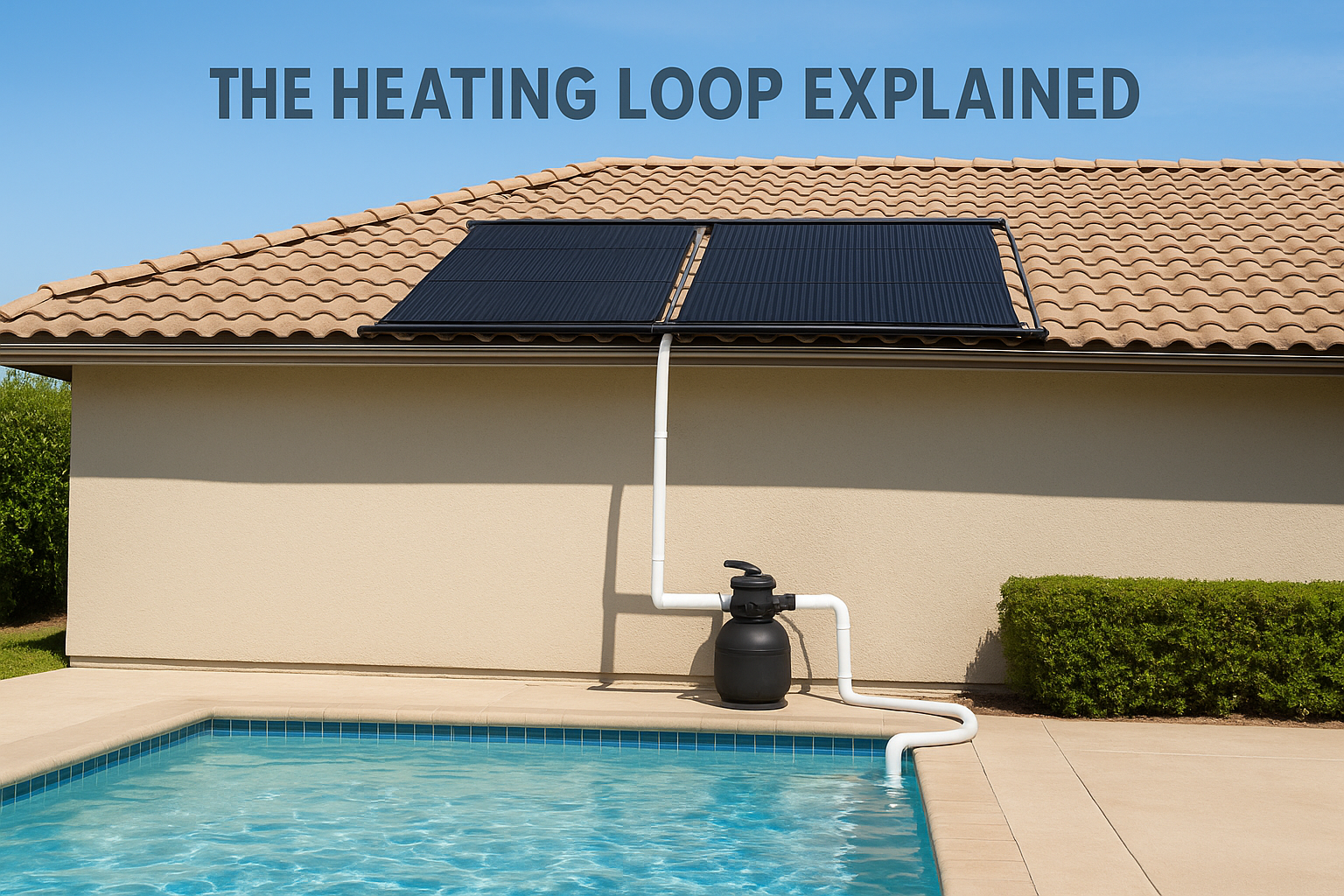
The process adds no fuel cost because the sun supplies all the energy needed to heat the water passing through the collectors.
What controls the flow
An automatic diverter valve sits between your filtration system and the collectors. When the controller detects that the collectors are warmer than the pool, it opens the valve and sends water up to the roof. When temperatures equalize or the sun drops, the valve closes and water bypasses the collectors entirely. This automatic cycling protects the system from running unnecessarily at night or on overcast days, which keeps your pool temperature consistent without any manual input from you.
Types of solar pool heaters and system setups
Not every solar pool heater works the same way, and knowing what is a solar pool heater in its different forms helps you choose the right option for your home. The two main collector types are unglazed and glazed panels, and your roof space, budget, and usage patterns all influence which setup fits your pool best.
Unglazed vs. glazed collectors
Unglazed collectors are the standard choice for Florida pools. They use black rubber or polypropylene tubes that absorb heat directly from the sun without any glass cover over the surface. Because Florida rarely sees temperatures low enough to cause significant surface heat loss, unglazed systems deliver strong performance at a noticeably lower upfront cost than glazed alternatives.
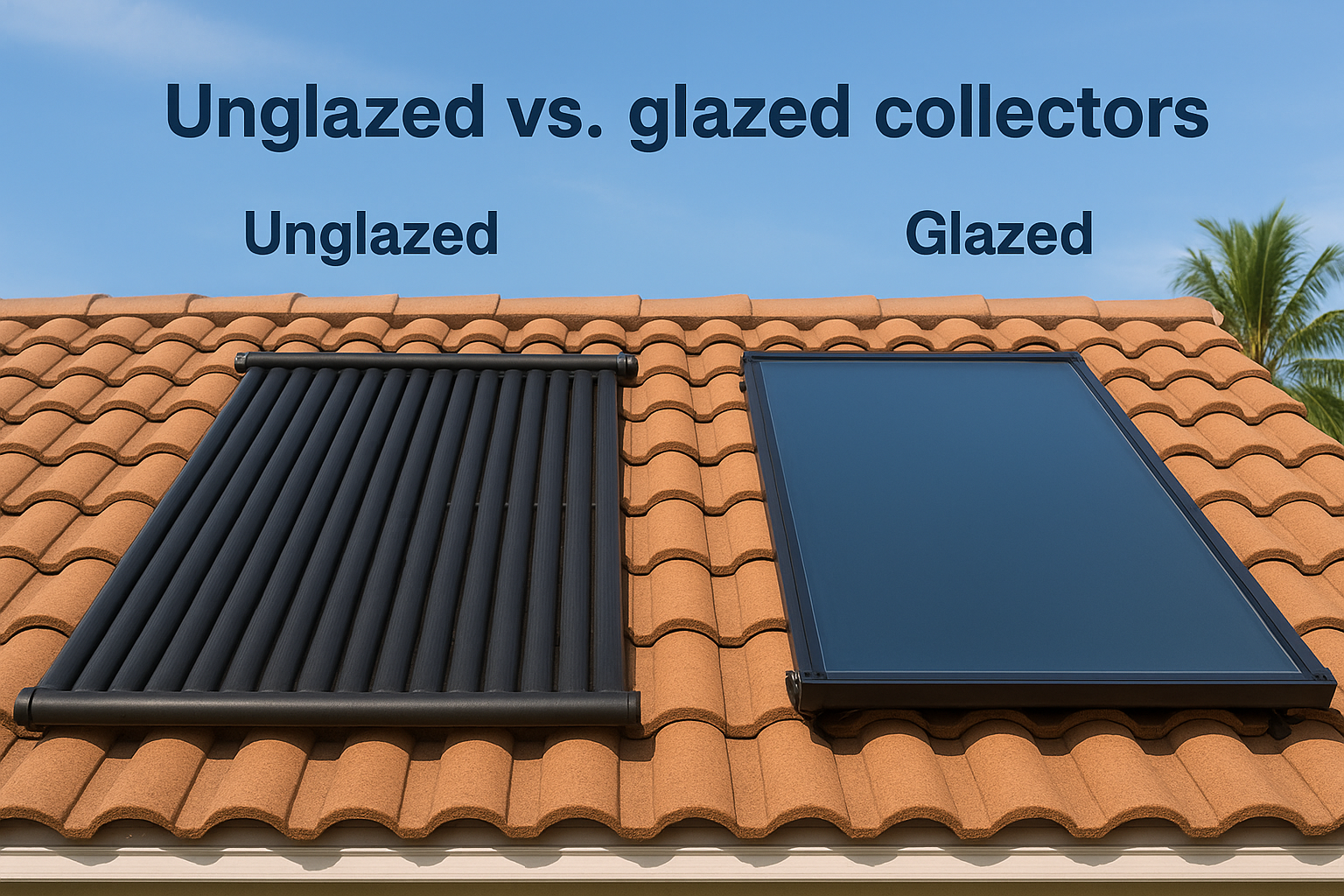
Glazed collectors make more sense in consistently cold climates, which makes them largely unnecessary for most Florida pool owners.
A glazed collector adds a glass cover and an insulated frame that reduce heat loss in colder conditions. They work better in northern climates or for combined solar water heating setups, but the added cost rarely justifies itself for a Florida swimming pool when an unglazed system performs just as well at a fraction of the price.
Mounting and system configuration
Roof mounting is the most common configuration for Florida homes because it uses your existing roof structure and keeps panels positioned for consistent sun exposure throughout the day. South-facing or southwest-facing roof sections produce the best results and require fewer total panels to heat your pool effectively.
Ground-mounted racks work well when roof orientation or shading limits your installation options, such as when most of your roof faces east-west. Your installer evaluates your home’s layout and calculates how many panels your specific pool size requires before recommending the right approach.
Cost, savings, and payback in Florida
Understanding what is a solar pool heater is only part of the decision; knowing what the system costs and how quickly it pays for itself determines whether it fits your budget. In Florida, solar pool heating systems typically cost between $3,000 and $6,000 installed, depending on your pool size, roof layout, and the number of collectors needed to maintain your target water temperature.
What you pay upfront
Most Florida homeowners with a standard residential pool pay $3,500 to $5,500 for a complete installation, which includes the collectors, controller, diverter valve, and all labor. Larger pools and homes requiring ground-mounted racks sit closer to the upper end of that range, while smaller pools with straightforward south-facing roofs often land at the lower end.
| Pool Size | Typical Installed Cost |
|---|---|
| Small (up to 15,000 gallons) | $3,000 to $4,000 |
| Medium (15,000 to 25,000 gallons) | $4,000 to $5,500 |
| Large (over 25,000 gallons) | $5,000 to $6,500 |
Payback period and long-term savings
Once the system is running, your pool heating operating costs drop to near zero, since the only ongoing expense is the small amount of electricity your existing pump uses to move water. Compared to gas, which can run $2,400 to $4,800 per year in Florida, most homeowners recover their full installation cost within three to seven years.
After payback, every swim season runs at no additional heating cost for the remaining life of the system.
A system that lasts 15 to 20 years gives you a decade or more of essentially free pool heating after you recover the initial investment, making solar one of the highest-return upgrades available for your pool.
Sizing, placement, and upkeep basics
Getting what is a solar pool heater right in practice depends on more than just buying the right collector type. Your specific pool volume, roof orientation, and local shading conditions all feed into a properly sized and positioned system, and skipping this step leads to undersized panels that struggle to hold temperature on cooler days.
Sizing your collector area
Your solar collectors need to cover 50 to 100 percent of your pool’s surface area in total square footage to perform effectively. Florida’s strong sun exposure means most pools land closer to the 50 to 70 percent range, but larger pools, heavily shaded roofs, or year-round heating goals push that number higher. A certified installer calculates this based on your pool’s volume, target temperature, and how many months per year you plan to swim.
Undersizing your collector area is the most common mistake homeowners make when budgeting a solar pool heating installation.
Placement and routine upkeep
South-facing or southwest-facing roof sections give your collectors the most consistent sun exposure throughout the day. When your roof lacks a strong south-facing section, a ground-mounted rack in a clear, open area of your yard delivers comparable performance without compromising your heating output.
Maintenance on a solar pool heating system is minimal compared to gas or electric alternatives. Rinsing debris off the panels a few times per year and scheduling an annual inspection of the controller, valves, and connections keeps most systems running without issue for well over a decade. Your installer checks for small cracks or UV degradation in the collectors during these visits before they become larger problems.
Next steps for your pool
Now that you understand what is a solar pool heater, how it works, and what it costs in Florida, you’re in a strong position to decide if it fits your home. The combination of low operating costs, a three-to-seven-year payback period, and a 15-to-20-year system lifespan makes solar pool heating one of the most practical upgrades available to Florida pool owners. Your pool size, roof orientation, and swim schedule all factor into the final system design, but the fundamentals stay the same.
Starting with a certified installer who can evaluate your roof and calculate your collector requirements gives you a real number to plan around. Advance Solar & Spa has been completing solar pool heating installations across Florida for over 40 years, with more than 50,000 installations finished by an in-house team. Contact our solar pool heating specialists to get a free estimate for your pool today.