What Is A Solar Power Purchase Agreement? Pros And Cons
-
Share
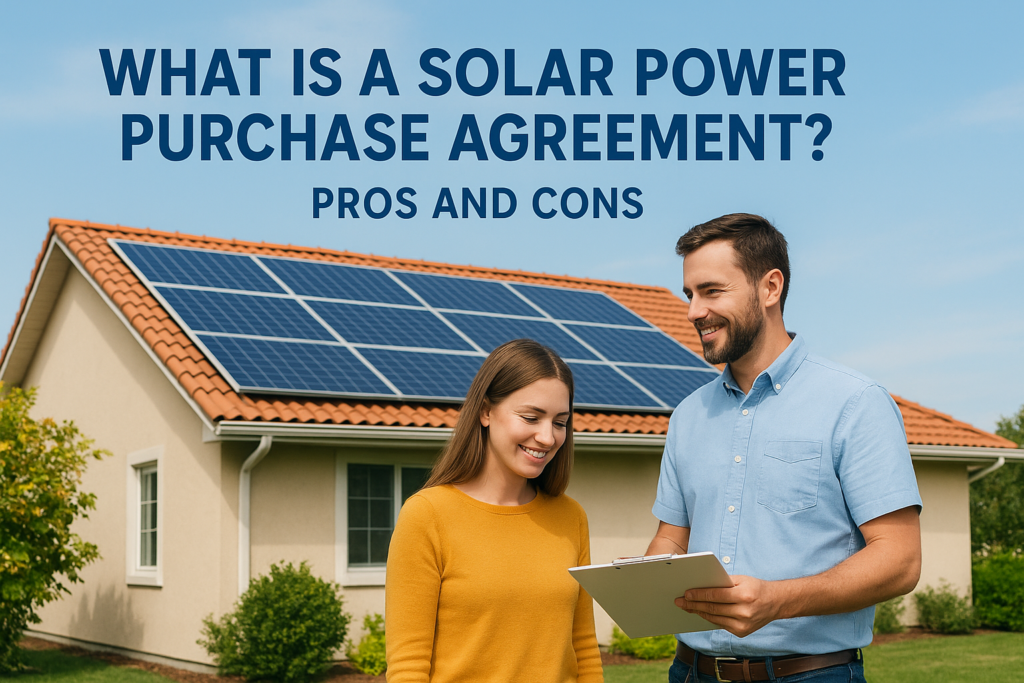
If you’ve started researching solar options for your Florida home or business, you’ve probably run into the term “solar power purchase agreement”, and wondered whether it’s the right fit for you. A PPA is one of several ways to go solar without paying the full system cost upfront, but it works very differently from a loan or a lease. Understanding those differences matters, because the financing path you choose affects your savings, your contract obligations, and your long-term energy costs.
At Advance Solar & Spa, we’ve spent over 40 years and more than 50,000 installations helping Florida property owners make informed solar decisions. We’ve seen every financing option come and go, and we know which ones actually deliver value. In this article, we’ll break down exactly how a solar PPA works, walk through the real pros and cons, and help you compare it against other options so you can choose with confidence.
Why solar PPAs matter for homeowners and businesses
Florida property owners are dealing with electricity rates that have climbed year over year, and that trend shows no sign of reversing. For anyone who wants to cut monthly energy costs but isn’t ready to spend $20,000 to $30,000 on a solar system upfront, a PPA removes that barrier entirely. You get solar panels installed on your roof at no upfront cost, and you pay the developer only for the electricity those panels produce.
The financial pressure driving PPA adoption
Understanding what is a solar power purchase agreement starts with understanding the problem it solves. Utility rates in Florida have increased by roughly 3 to 5 percent annually over recent years, which means the average homeowner is paying significantly more for power than they were five years ago. A PPA locks in your electricity rate or sets a predictable escalation cap, giving you more control over what you’ll spend.
Locking in a below-market electricity rate through a PPA can produce real monthly savings from day one, even without any upfront investment.
For homeowners in hurricane-prone regions, that rate predictability matters even more. Storm-related grid outages drive up demand and often precede rate adjustments, so having a fixed or capped rate on solar-generated power provides a financial buffer that standard utility contracts don’t offer.
Why businesses treat PPAs differently than homeowners
For commercial property owners, the financial stakes around energy contracts are higher. Businesses consume far more electricity than residences, so a poorly structured agreement can carry significant long-term risk. On the other hand, a well-negotiated PPA can stabilize operating costs and protect against rate spikes that hit hard during peak seasons.
Many Florida businesses also use PPAs to meet internal sustainability goals without tying up capital in owned equipment, which keeps cash available for core operations.
How a solar PPA works step by step
A solar PPA follows a straightforward process once you understand what is a solar power purchase agreement and how the parties involved interact. A third-party developer owns, installs, and maintains the solar system on your property. You sign a contract agreeing to buy the electricity the system generates at a set rate, which is typically lower than your current utility rate.
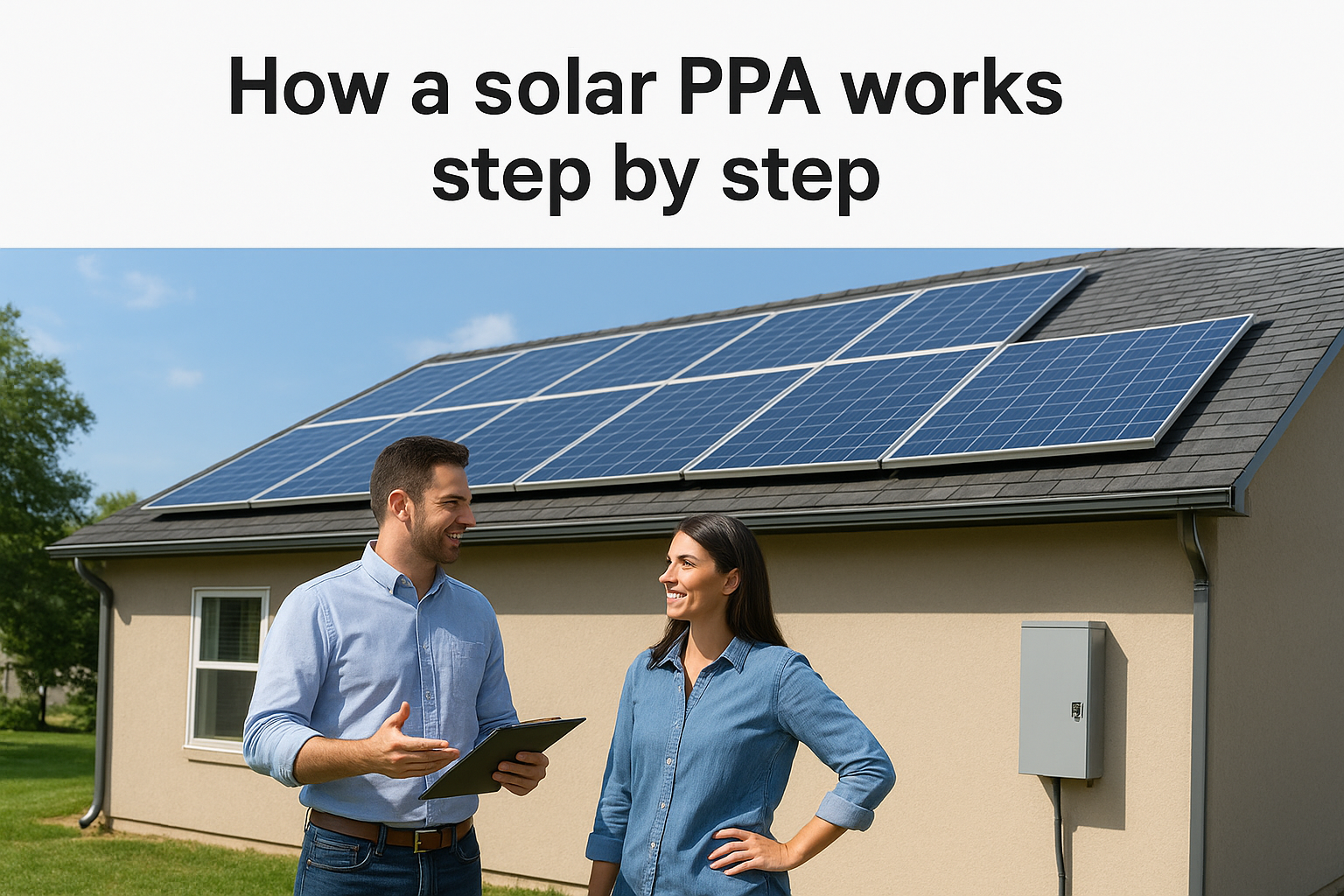
You never own the panels, but you benefit from the clean energy they produce at a predictable, often lower cost.
The installation and billing process
The developer handles all permits, equipment, and installation costs at no charge to you. Once the system goes live, your bill reflects only the kilowatt-hours your panels actually generate. Your utility still supplies power during nights or cloudy days, and you pay the utility separately for that portion. Most PPA contracts run 15 to 25 years, and many include an escalator clause that raises your rate by a small fixed percentage each year.
What happens at the end of the contract
When your contract term ends, you typically have three options: renew the agreement, have the developer remove the panels, or purchase the system at fair market value. Each path carries different financial implications depending on your long-term property plans, so it pays to review these terms carefully before signing.
Key PPA terms that affect your total cost
When you’re evaluating what is a solar power purchase agreement, the contract terms determine whether the deal actually saves you money over time. Two terms in particular will shape your total cost more than anything else: the per-kilowatt-hour rate you agree to pay at signing, and the annual escalator percentage built into the contract.
The escalator rate
Most PPAs include an annual escalator, typically between 1 and 3 percent, that raises your electricity rate each year. That percentage compounds over a 20-year contract, so a low starting rate can end up costing you more than expected by year 15. Compare your escalator rate against historical utility rate increases in your area before you sign.
A 3 percent annual escalator over 20 years can more than double your per-kilowatt-hour cost from the original rate.
Buyout options and transfer clauses
Your contract should also clearly define buyout pricing if you want to purchase the system before the term ends. This matters especially when you plan to sell your home. Review these key transfer-related terms before signing:
- Assumability: whether a buyer can take over your PPA
- Prepayment penalties: fees for early contract termination
- Fair market value formula: how the buyout price gets calculated at each contract stage
Solar PPA pros and cons for Florida properties
Florida’s high solar irradiance and rising utility rates create a specific context for evaluating what is a solar power purchase agreement. The state averages more than 230 sunny days per year, which means your system will generate substantial electricity, making the per-kilowatt-hour rate you lock in through a PPA more impactful on your total savings.
The advantages worth knowing
You gain real benefits from a PPA in Florida. No upfront cost removes the biggest obstacle for most people, and the developer handles all maintenance throughout the contract term, which matters in a state where heat and humidity accelerate equipment wear. You also benefit from immediate monthly savings if your PPA rate sits below your current utility rate.
- No out-of-pocket installation expense
- Maintenance and repairs covered by the developer
- Predictable electricity costs during storm season
The drawbacks to weigh carefully
Long contract terms and escalator clauses carry real risk. If utility rates drop or your property value changes, you could be locked into a rate that no longer makes financial sense.
Selling your Florida home becomes more complicated if the buyer cannot or will not assume your PPA contract.
You also miss out on tax incentives like the federal solar tax credit, which goes to the system owner, not you.
Solar PPA vs lease vs buying solar panels
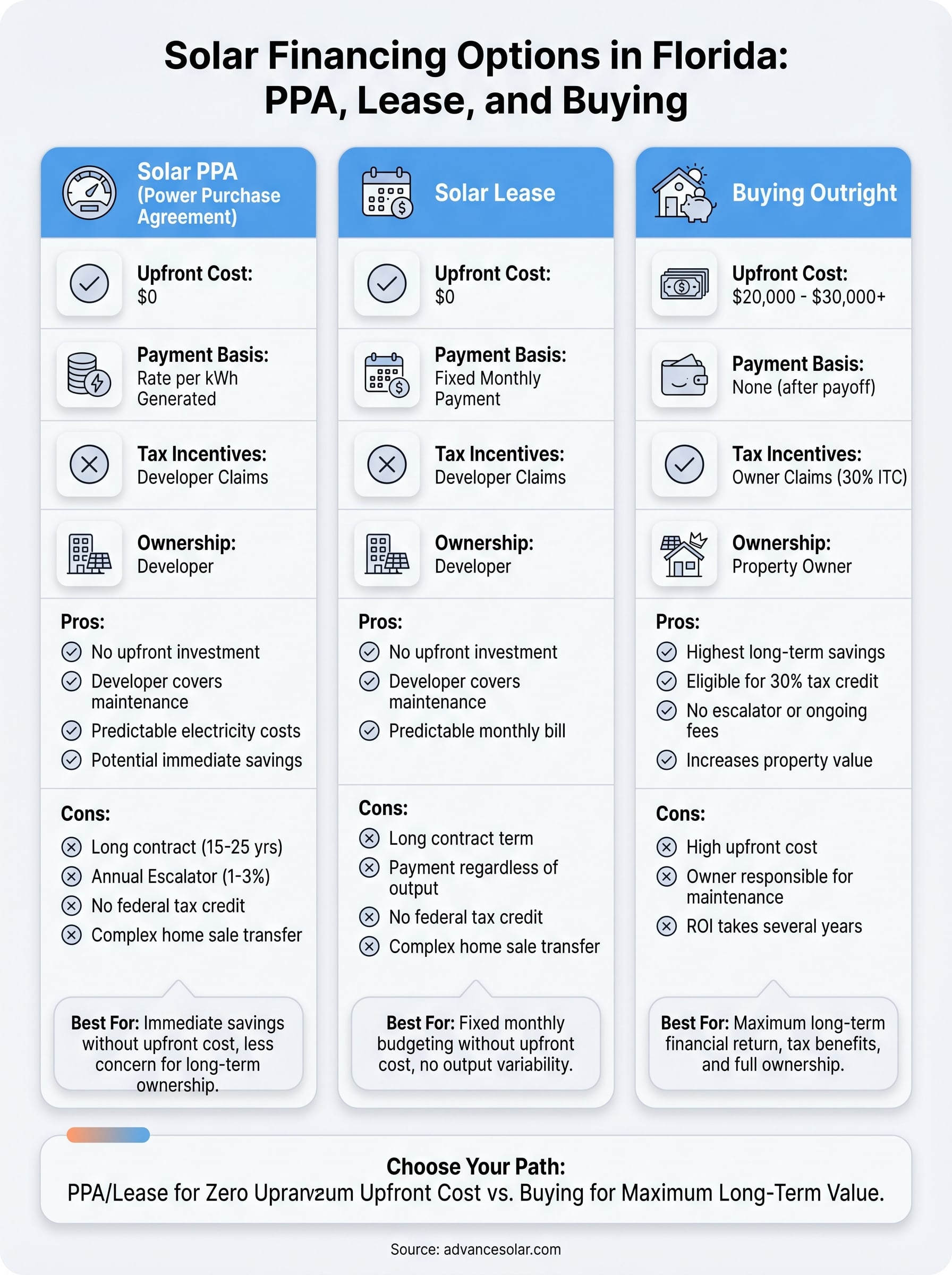
When you’re asking what is a solar power purchase agreement, it helps to line up all three financing options side by side. All three approaches install panels on your property, but they produce very different outcomes for ownership, tax benefits, and long-term savings potential.
The financing path you choose on day one shapes your energy costs for the next 20 to 25 years.
PPA vs lease: the key difference
A solar lease charges you a fixed monthly payment regardless of how much electricity your panels actually produce. A PPA charges you only for kilowatt-hours generated, so a lower-output month means a lower bill. Both options leave panel ownership with the developer, and neither qualifies you for the federal solar tax credit.
Under either arrangement, you skip the upfront cost but also give up long-term financial control compared to owning the equipment outright.
Why buying outperforms both
Purchasing your system outright gives you access to the 30 percent federal Investment Tax Credit, which flows to the system owner, not a third-party developer. You face no escalator clauses, no contract transfer complications when you sell your home, and no ongoing payments once the system is paid off. Over a typical 25-year system lifespan, ownership delivers the highest total savings of the three options.
Your next steps
Now that you understand what is a solar power purchase agreement, you can evaluate whether it fits your property and financial goals. A PPA removes the upfront cost barrier, but it also removes long-term ownership benefits and tax incentives that make buying outright the stronger financial move for most Florida homeowners and businesses.
Before you commit to any financing path, get a clear energy analysis from a team that knows Florida solar inside and out. Advance Solar & Spa has completed more than 50,000 installations across the state using in-house crews, not subcontractors, and we hold every license needed to handle your project from start to finish. Contact our team at Advance Solar & Spa to get a free consultation and find out which solar option delivers the best return for your specific situation.