
If you’re a Florida homeowner considering backup power, one of the first questions you’ll ask is: what does solar battery storage cost in 2026? It’s a fair question, and the answer isn’t as straightforward as a single price tag. Battery prices depend on the system size, the brand, installation complexity, and whether you qualify for federal and state incentives that can cut the total cost significantly.
At Advance Solar & Spa, we’ve installed over 50,000 solar energy systems across Florida since 1983. As both a Tesla Certified Installer and Enphase Platinum Installer, we work with the two most sought-after battery platforms on the market, and we see the real numbers behind every project. That firsthand experience gives us a clear picture of what homeowners actually pay, not just what manufacturers advertise.
This article breaks down current battery storage pricing, walks through the tax credits and incentives available to Florida residents, and examines whether the investment delivers a solid return. Whether you’re pairing batteries with a new solar panel system or adding storage to an existing one, you’ll leave with the specific cost data you need to make a confident decision, along with a realistic look at long-term savings and payback timelines.
Why solar battery storage cost matters in 2026
Understanding solar battery storage cost isn’t just a budgeting exercise. In 2026, it’s a decision shaped by three converging forces: rising utility rates, a federal incentive window that won’t stay open forever, and a Florida grid that continues to buckle during hurricane season. Getting the numbers right now can mean the difference between a smart long-term investment and an expensive purchase that doesn’t pay off on your timeline.
Florida’s grid reliability problem
Florida homeowners deal with a reality most other states don’t face: hurricane-season power outages that can last days or even weeks. The U.S. Energy Information Administration consistently ranks Florida among the states with the longest average outage durations, driven by severe weather events. When the grid goes down, a home without battery backup loses access to all solar-generated power, because standard grid-tied systems shut off automatically to protect utility workers from backfed electricity.
A battery system keeps your home running during an outage, which means your solar panels stay useful precisely when the grid fails you most.
That vulnerability reframes the entire storage conversation. The cost of losing power for three to five days, including spoiled food, hotel stays, and generator fuel, can easily run $1,000 to $2,000 per event. Batteries stop looking like a luxury and start looking like essential infrastructure.
Utility rates keep climbing
Florida residents have watched electricity bills rise steadily over the past decade. According to the U.S. Energy Information Administration, residential electricity prices have increased by more than 30% nationally over the last ten years, with Florida tracking closely to that trend. Major Florida utilities have filed for rate increases in recent years, and those requests historically get approved.
Higher utility rates directly strengthen the financial case for battery storage. When you store solar energy during the day and use it in the evening instead of buying power from the grid, every kilowatt-hour you self-consume saves more money than it did five years ago. That math keeps improving as rates climb.
Battery technology has matured while costs stabilized
The battery storage market in 2026 looks very different from where it stood in 2019. Lithium iron phosphate (LFP) chemistry has largely replaced older lithium-ion formulations in residential storage, delivering longer cycle life and better thermal stability in Florida’s heat. Platforms from Tesla and Enphase have matured to the point where reliability is no longer a major concern for most homeowners.
Pricing has also stabilized. The dramatic cost drops of the early 2020s have mostly leveled off, and waiting another year in hopes of a sharp price reduction is not the strategy it once was. What remains firmly in place is strong federal support through the Investment Tax Credit, which continues to make 2026 a favorable year to buy rather than delay.
What you are paying for in a battery system
When you look at a quote for solar battery storage, the total price reflects several distinct cost categories. Understanding each one helps you compare quotes accurately and avoid being surprised by line items that some installers bury in the fine print. The solar battery storage cost on any proposal should always be itemized so you know exactly what you’re funding before you sign anything.
The battery unit itself
The battery hardware is the largest single line item in most quotes. Residential batteries from Tesla and Enphase carry different price points because they use different architectures. The Tesla Powerwall 3 is a fully integrated unit that includes its own inverter, while Enphase IQ batteries pair with Enphase microinverters already installed on your panels. Both platforms use lithium iron phosphate chemistry, which handles Florida’s heat better than older formulations and delivers longer usable cycle life.
The capacity you choose, measured in kilowatt-hours, drives the hardware cost more than any other single factor. Most Florida homeowners install one to three battery units, depending on how much of their home they want to run during an outage. Adding a second or third unit costs less per unit than the first, because installation labor doesn’t scale at the same rate as hardware.
Installation and electrical work
Labor and electrical materials typically account for 15% to 25% of your total project cost. This covers mounting the battery, running conduit, connecting the system to your existing solar setup, and tying into your utility meter. Homes with older wiring or complex electrical configurations need more work, which pushes this number higher. A panel upgrade, if your current breaker box is near capacity, adds a separate but necessary cost.
If your electrical panel was installed before 2010 or is already near its limit, plan for an upgrade as part of your storage project budget.
Permitting and system commissioning
Permitting fees and utility interconnection requirements are real costs that appear on every legitimate quote. Florida municipalities require permits for battery storage installations, and your utility must approve the final configuration. System commissioning involves testing backup switchover, confirming proper operation, and registering the manufacturer warranty, all of which a licensed installer handles on your behalf.
Typical solar battery storage costs in 2026
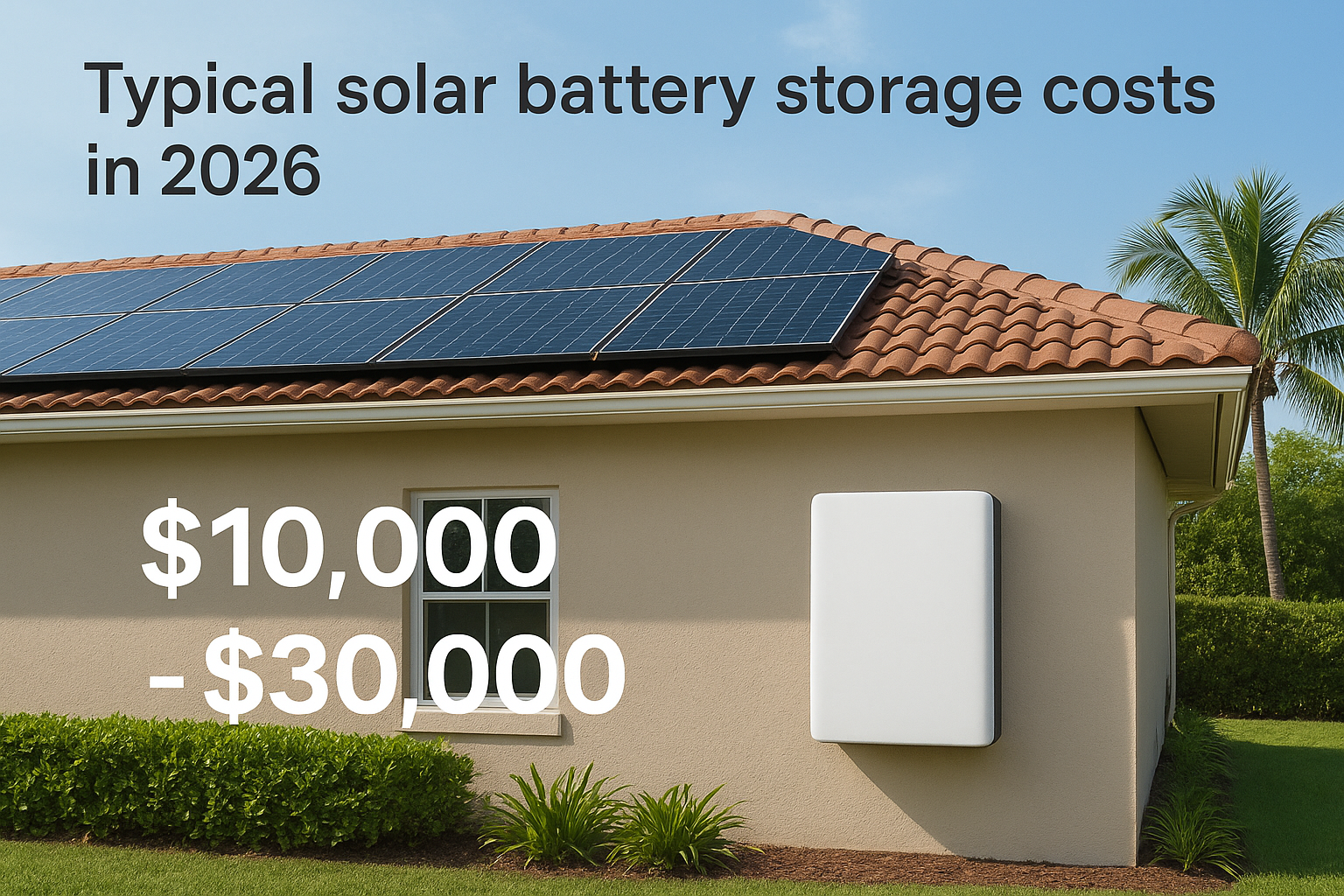
The solar battery storage cost for a typical Florida home in 2026 falls between $10,000 and $30,000 installed, before any tax credits or incentives apply. That range sounds wide, but it narrows quickly once you know how many battery units your home actually needs and which platform you’re installing.
Single-battery systems
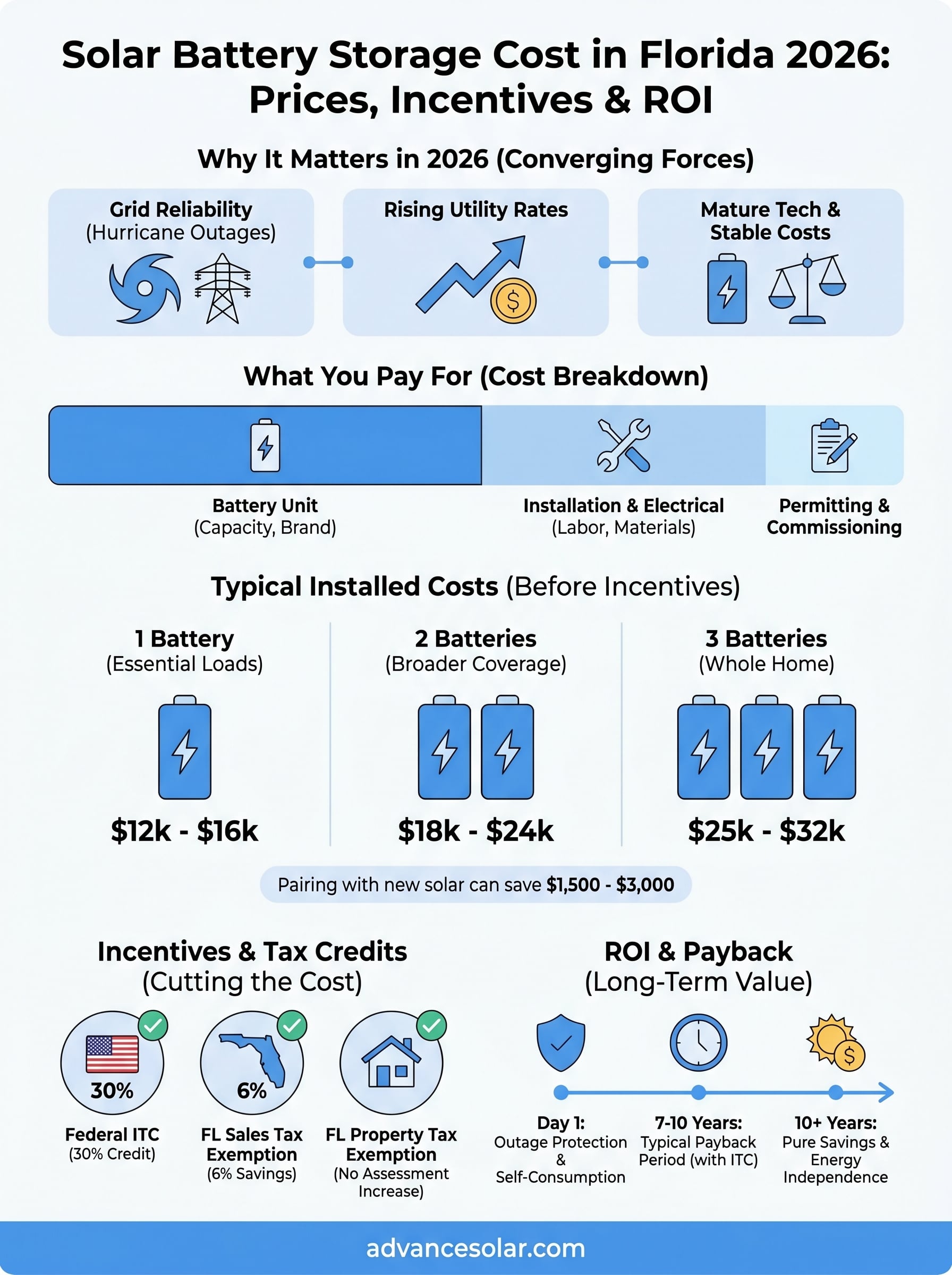
A single Tesla Powerwall 3 or Enphase IQ Battery 5P covers your essential loads during an outage: refrigerator, lights, router, phone charging, and a handful of outlets. Installed cost for a one-unit system runs approximately $12,000 to $16,000 before incentives. This tier works well for homeowners who want reliable outage protection for critical appliances without the goal of powering the whole house.
A single battery handles the basics during an outage, but if you run a well pump, central AC, or medical equipment, plan for at least two units.
Multi-battery systems
Two-battery systems land in the $18,000 to $24,000 installed range and cover a much broader set of loads, including well pumps and partial air conditioning. Three-battery configurations push into the $25,000 to $32,000 range and can sustain nearly the full home through an extended outage. Most Florida homeowners with larger properties or whole-home backup goals end up in this tier after reviewing their actual energy usage.
The table below gives you a straightforward reference for each system size:
| System Size | Usable Capacity | Approximate Installed Cost (Before Incentives) |
|---|---|---|
| 1 battery | 13-15 kWh | $12,000 – $16,000 |
| 2 batteries | 26-30 kWh | $18,000 – $24,000 |
| 3 batteries | 39-45 kWh | $25,000 – $32,000 |
Pairing storage with a new solar system
Adding batteries at the same time as a new solar panel installation typically costs less than retrofitting storage to an existing system. When both projects run under the same contract, your installer shares mobilization, permitting, and electrical work across both scopes. That combined approach can save $1,500 to $3,000 compared to treating them as two separate jobs scheduled months apart.
What drives your price up or down
Several variables pull your solar battery storage cost higher or lower, and knowing them before you request a quote gives you real leverage. Two homeowners in the same Florida county can receive quotes that differ by $5,000 or more simply because their homes present different installation conditions. Understanding what sits behind those numbers helps you ask better questions and spot quotes that don’t reflect your actual project scope.
Your home’s electrical setup
The condition of your electrical panel is one of the most significant cost drivers in any storage project. Older panels built before modern load requirements often need an upgrade before a battery system can connect safely. Panel upgrades typically add $1,500 to $3,500 to your project total, depending on the amperage increase and local permitting requirements. If your breaker box is already near capacity or uses outdated fusing, budget for this work upfront rather than facing a surprise after the installation starts.
Your home’s wiring layout also affects how much conduit and labor your installer needs to run between the battery, the inverter, and the utility meter. Longer runs cost more. A detached garage, a second subpanel, or a pool load that you want included in your backup coverage all add scope to the electrical work and push the total higher.
Battery brand and capacity choices
Brand selection affects your final price more than most homeowners expect. Tesla Powerwall 3 units are priced differently from Enphase IQ Battery 5P units, and the right choice depends on what inverter platform your solar panels already use. Mixing brands incorrectly adds integration costs that can wipe out any savings from choosing the cheaper unit upfront.
Choosing the right battery brand for your existing solar setup matters as much as the unit price itself.
Capacity, measured in kilowatt-hours, is the most direct lever you control. Each additional battery unit you add increases your stored energy and your upfront cost in roughly equal proportion. The goal is to match your actual backup load requirements to the right number of units, not to overbuy capacity you’ll rarely use or underbuy and find yourself short during a multi-day outage after a major storm.
Incentives and tax credits that cut the cost
Before you finalize any budget for solar battery storage cost, you need to account for the incentives currently available to Florida homeowners. These programs can reduce your out-of-pocket cost by 30% or more, and they apply to battery storage whether you’re adding it to an existing solar system or installing it alongside new panels.

The federal Investment Tax Credit
The federal Investment Tax Credit (ITC) remains the most powerful incentive available in 2026. It gives you a tax credit equal to 30% of your total installed system cost, including the battery hardware, labor, permits, and any electrical upgrades directly tied to the storage installation. That credit comes directly off your federal tax liability, not just your taxable income, which makes it far more valuable than a deduction.
If your total installed battery cost is $20,000, the ITC returns $6,000 directly to you when you file your federal taxes.
You claim the credit in the tax year when your system is placed in service, meaning fully installed and operational. The IRS administers this credit through Form 5695. If your tax liability in a single year is less than the full credit amount, you can carry the remaining balance forward into the following tax year.
Florida state tax benefits
Florida adds two more layers of financial relief on top of the federal credit. First, solar energy systems, including battery storage, are fully exempt from Florida sales tax under state law, which saves you the standard 6% sales tax on all equipment. On a $20,000 system, that’s $1,200 back in your pocket without filing any additional paperwork.
Second, Florida’s property tax exemption for renewable energy means that adding battery storage to your home does not increase your assessed property value for tax purposes. Your home becomes more valuable on the market, but your annual property tax bill stays unchanged.
Utility rebates and programs
Some Florida utilities offer additional demand response or rebate programs tied to battery storage. These programs vary by utility territory and change periodically, so your installer should confirm current availability in your specific area during the quoting process.
How to size storage and judge ROI in Florida
Getting the storage sizing right is the step that determines whether your battery system actually pays off. If you undersize, you run out of power during a multi-day outage. If you oversize, you spend money on capacity you rarely use. The right starting point is a review of your actual energy usage, which your installer can pull directly from your utility account with your permission.
Sizing your system to your real backup needs
Florida homeowners typically want to cover two scenarios: routine evening use when solar panels aren’t producing, and multi-day outage coverage after a hurricane or major storm. These two goals often point to different system sizes, and your installer should model both before recommending a unit count. A home that uses 30 to 45 kilowatt-hours per day on average needs to prioritize which loads matter most during an outage rather than trying to run everything on battery power alone.
Start by listing your critical loads, including the refrigerator, lighting, medical equipment, router, and phone charging. Add the loads you consider important but not essential, such as a window AC unit or well pump. Your installer uses this list to calculate the minimum battery capacity for your backup window, whether that’s 24 hours or 72 hours.
Calculating your ROI in Florida’s rate environment
Return on investment for battery storage in Florida comes from two separate sources: utility bill savings from self-consuming stored solar energy instead of buying grid power at peak rates, and avoided costs from outages you no longer have to weather with a generator or hotel stay. When you combine both, the financial picture improves significantly compared to looking at utility savings alone.
Most Florida homeowners who pair battery storage with a correctly sized solar system see a combined payback period of 7 to 10 years after applying the 30% federal Investment Tax Credit.
After that payback window, the stored energy you consume costs you nothing beyond routine maintenance. With battery warranties typically covering 10 years of operation and Florida’s steadily rising utility rates working in your favor, the long-term math on solar battery storage cost continues to improve the longer you hold the system.
Next steps
You now have a clear picture of solar battery storage cost in 2026, from hardware pricing and installation variables to the 30% federal Investment Tax Credit and Florida’s sales and property tax exemptions. The numbers show that battery storage is a practical investment for most Florida homeowners, particularly when you factor in rising utility rates and the real cost of hurricane-season outages.
Your next move is to get a quote built around your specific home, not a generic estimate pulled from a national average. Every project is different, and the right system size, battery platform, and electrical scope depend on your actual usage, your panel setup, and your backup priorities. Advance Solar & Spa has been installing battery systems across Florida for over 40 years with an in-house licensed team and no subcontractors. Request a free solar battery storage consultation and get real numbers for your home before making any final decisions.