
Your solar inverter is the single most failure-prone component in a photovoltaic system. It converts DC power from your panels into usable AC electricity, and when it dies, your entire system stops producing. That’s why a solar inverter warranty comparison matters more than most homeowners realize, the difference between a 12-year and a 25-year warranty could mean thousands of dollars in out-of-pocket repair or replacement costs.
But warranty length is only part of the story. What’s actually covered? Does the manufacturer pay for labor, or just ship you a box? Will they cover shipping both ways, or leave you hunting for a certified installer to handle the swap? These details vary wildly between brands, and they’re rarely spelled out in the glossy sales brochures. At Advance Solar & Spa, we’ve installed over 50,000 systems across Florida since 1983, and we’ve filed warranty claims with every major inverter manufacturer on this list. That hands-on experience gives us a clear picture of which warranties actually deliver when something goes wrong.
In this article, we rank seven leading inverter brands, including string inverters and microinverters, based on warranty duration, coverage terms, transferability, and real-world claim experience. Whether you’re planning a new solar installation or evaluating equipment options for your Florida home or business, this breakdown will help you make a confident, informed decision about the hardware protecting your investment.
1. Advance Solar & Spa
Most homeowners focus exclusively on manufacturer warranties when doing a solar inverter warranty comparison, but the installer you choose shapes your total protection just as much as the brand printed on the inverter. Advance Solar & Spa has operated in Florida since 1983, completing over 50,000 installations with an in-house team of more than 50 licensed employees across solar, electrical, pool, and HVAC disciplines. That depth of experience puts them in a position to back their work in ways that subcontractor-dependent installers simply cannot replicate.
What warranty support looks like from an installer
Advance Solar & Spa provides a workmanship warranty on every installation, completely separate from whatever the inverter manufacturer offers. Their in-house licensed team can diagnose problems directly, covering the wiring, mounting, conduit runs, and electrical connections that a manufacturer’s policy never touches. When something goes wrong, you deal with one accountable company rather than a chain of disconnected vendors pointing fingers at each other.

The installer’s workmanship warranty is your safety net when a manufacturer claim stalls or a defect falls in a gray area between equipment failure and installation error.
How they help you navigate manufacturer warranties
Filing an inverter warranty claim is rarely as simple as calling a toll-free number and waiting for a replacement. Advance Solar & Spa handles the claim documentation, communicates directly with the manufacturer, and coordinates the replacement or repair once it gets approved. Their standing as an Enphase Platinum Installer and Tesla Certified Installer gives them access to manufacturer support channels that a homeowner calling independently would not receive, which shortens resolution timelines in practice.
What to confirm in the workmanship warranty
Before signing any installation contract, ask for the workmanship warranty term in writing and get specific answers on these points:
- Whether it covers roof penetrations and waterproofing around conduit and mounting hardware
- Whether the warranty transfers to a new owner if you sell the home
- Whether return visits within the covered term carry additional labor charges
- How long after installation the coverage remains active
Advance Solar & Spa documents all of this upfront, which eliminates disputes well after the panels are producing power.
How service access affects total warranty value
A warranty is only as good as the team available to honor it. Advance Solar & Spa’s in-house service department means you call one number and a licensed technician arrives, someone from the same company that designed and built your system. That continuity reduces diagnostic errors and scheduling delays that routinely add weeks to what should be a simple inverter swap under warranty coverage.
2. Enphase
Enphase makes microinverters, meaning one unit mounts behind each individual panel rather than processing power for the entire array from a single box. That architecture changes how warranties work in a solar inverter warranty comparison because a single unit failing never brings your whole system offline.
Standard term and extension options
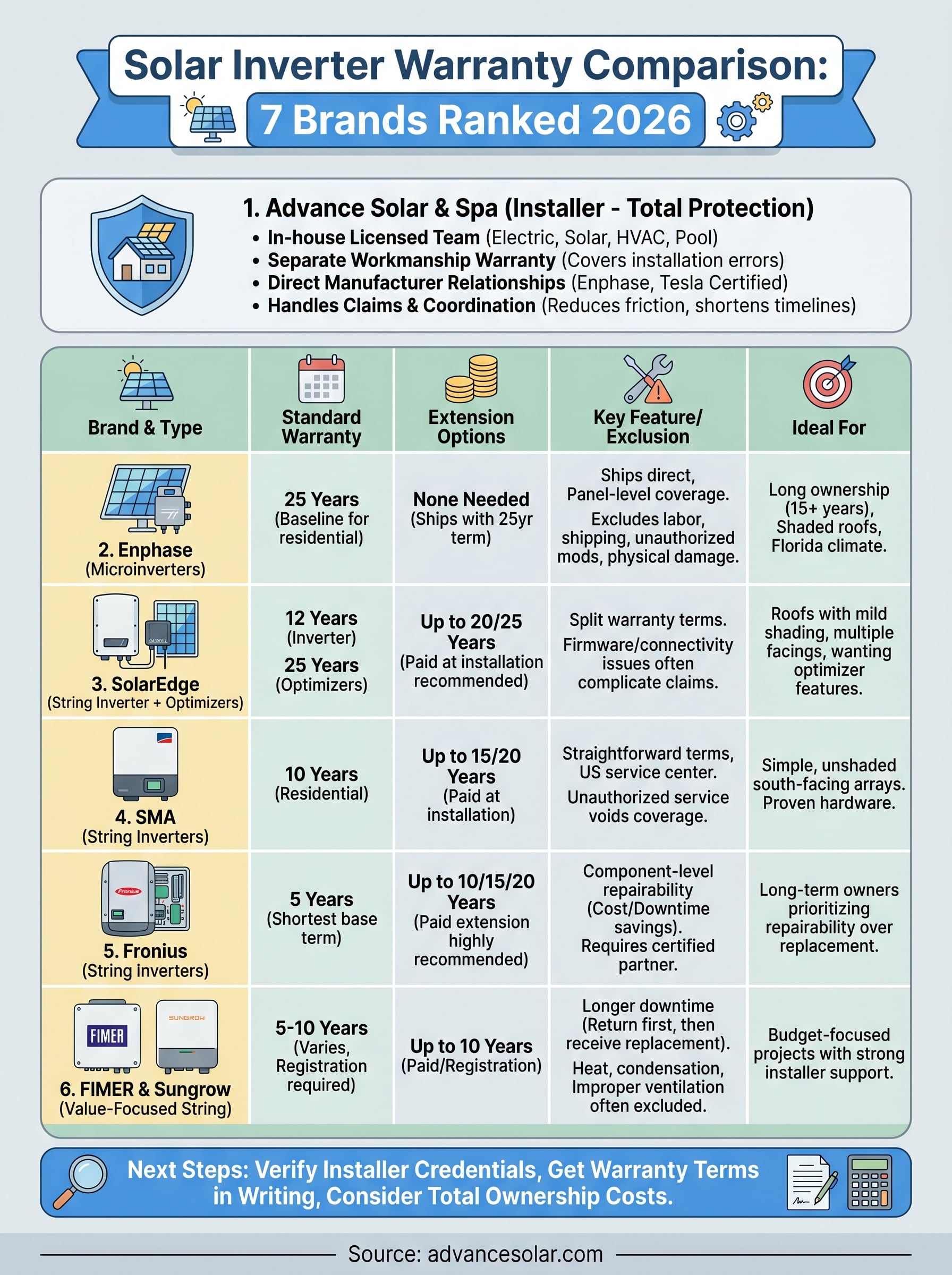
Enphase covers its residential microinverters for 25 years as the standard warranty term on IQ Series products, which matches the expected lifespan of most solar panels. You do not need to purchase a separate extension to reach that 25-year figure; Enphase ships it as the baseline for residential installations, which is one of the strongest starting points among any inverter manufacturer on this list.
What it covers and what it excludes
Product defects and premature failure fall squarely within Enphase’s coverage, but physical damage from improper installation, lightning strikes, or flooding does not. Enphase also excludes damage caused by unauthorized modifications, meaning any work performed outside of approved procedures can void coverage on the affected units before you ever file a claim.
Always confirm your installer holds active Enphase certification, because uncertified work can invalidate a warranty claim on the exact unit you need replaced.
Labor, shipping, and replacement unit expectations
Enphase ships replacement microinverters directly at no charge once a claim is approved. Labor for the physical swap on your roof is typically not included, so factor in a service call cost when estimating your real out-of-pocket exposure during a warranty event.
Best fit for Florida roofs and long ownership timelines
Florida’s afternoon cloud cover and frequent shading from palm trees and roofline obstructions make Enphase’s panel-level production a practical fit for most residential roofs. If you plan to own your home beyond 15 years, the 25-year baseline removes one significant cost variable from your long-range budget.
3. SolarEdge
SolarEdge takes a different architectural approach than Enphase by pairing a central string inverter with individual DC power optimizers mounted behind each panel. That combination gives you panel-level monitoring and production optimization without going full microinverter, which affects how the warranty structure works in ways worth understanding before you commit to the equipment.
Standard term and extension options
SolarEdge ships residential string inverters with a 12-year standard warranty, which you can extend to either 20 or 25 years by purchasing an extended coverage plan at the time of installation. Buying the extension later typically costs significantly more, so locking it in upfront is the smarter financial move if you plan to stay in your home long-term. For a full solar inverter warranty comparison, that 12-year baseline puts SolarEdge behind Enphase on starting coverage without an extension.
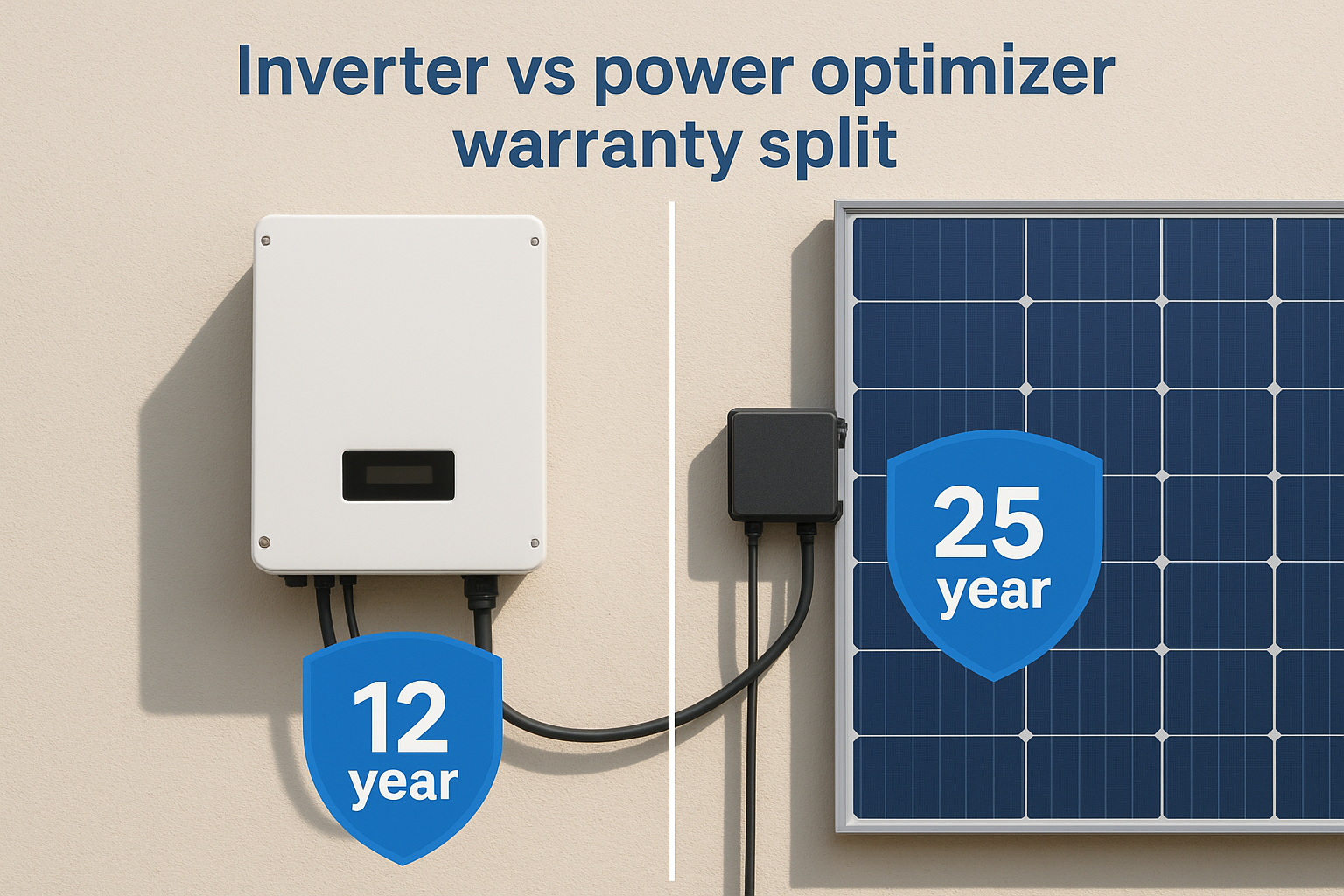
Inverter vs power optimizer warranty split
The power optimizers carry a separate 25-year warranty that runs independently from the inverter coverage. This split means a failed optimizer and a failed inverter involve two different claim processes with potentially different resolution timelines, so tracking both warranty terms matters from day one of ownership.
What often trips up SolarEdge claims
Firmware and software connectivity issues frequently complicate SolarEdge claims because the system relies on cloud monitoring and communication modules that have their own failure modes. If the monitoring system goes offline, isolating whether the inverter hardware or the communication hardware caused the problem adds diagnostic time to your claim.
Confirm your installer documents the monitoring system setup at commissioning, because communication failures that go unlogged can complicate the claims process later.
Best fit for projects that want optimizer features
SolarEdge works well for roofs with mild shading or multiple roof facings where optimizer-level control adds measurable production value. If your roof has a clean southern exposure with minimal obstruction, the optimizer premium may deliver less benefit relative to what a simpler string inverter setup would cost.
4. SMA
SMA is a German string inverter manufacturer with a well-established US service network and a warranty structure that rewards simplicity. Their hardware appears frequently in residential and commercial installations, and their straightforward coverage terms make them relatively easy to evaluate in a solar inverter warranty comparison without tracking multiple overlapping policies.
Standard term and extension options
Residential Sunny Boy inverters ship with a 10-year standard warranty on most models sold in the US market. You can extend that coverage to 15 or 20 years through SMA’s paid extension program, which you should purchase at installation to get the best available rate. Waiting until your standard coverage nears expiration will cost you noticeably more for the same protection.
What it covers and what it excludes
The warranty covers manufacturing defects and component failures under normal operating conditions. It excludes damage from improper installation, grid surges, flooding, and physical impact. Work performed by non-authorized service partners can void your coverage entirely, so confirming your installer holds active SMA authorization before any work starts protects your claim eligibility from the first day of operation.
Verifying your installer’s SMA authorization status before signing a contract is the step most homeowners skip, and it can permanently close the warranty door when you need it most.
Claim workflow, lead times, and downtime risk
Claims run through SMA’s domestic US service center, which reduces the international shipping delays that European-based manufacturers sometimes create. Replacement units typically arrive within one to three weeks after claim approval, meaning your system produces nothing during that window. In Florida’s peak summer months, that downtime translates directly into higher utility bills.
Best fit for straightforward string inverter systems
SMA performs best on unshaded roofs with a clean south-facing array where optimizer technology adds cost without delivering meaningful production gains. If your priority is proven hardware with simple warranty terms and no multiple coverage tiers to track separately, SMA fits that profile well.
5. Fronius
Fronius is an Austrian manufacturer whose residential and commercial inverters have built a strong reputation for one specific reason: the hardware is designed to be repaired at the component level rather than replaced as a complete unit. That distinction matters more in Florida’s heat and humidity than it might in a milder climate, and it shapes how Fronius stacks up in any solar inverter warranty comparison.
Standard term and extension options
Fronius ships its residential Primo line with a standard 5-year warranty, which is the shortest base term on this list. You can extend coverage to 10, 15, or 20 years through a paid extension purchased at installation. Because the base term is short, buying an extension at signing is essentially mandatory if you want coverage that aligns with your panel lifespan.
What it covers and what it excludes
The warranty covers manufacturing defects and internal component failures under normal operating conditions. Physical damage, flooding, unauthorized repairs, and installation errors fall outside the policy, as they do with every major manufacturer on this list.
Confirm that your installer holds active Fronius certification before signing anything, because unauthorized service work can void your claim eligibility on the spot.
Serviceability factors that impact real costs
Fronius inverters use a modular internal design that allows a certified technician to replace a failed power stage or control board without swapping the entire unit. That repairability can cut both cost and downtime significantly compared to brands that treat every failure as a full replacement event.
Best fit for owners who prioritize repairability
Fronius suits homeowners who plan a long ownership horizon and want a system that can be maintained and repaired rather than repeatedly replaced, particularly if they already have a qualified Fronius service partner nearby.
6. FIMER and Sungrow
FIMER and Sungrow both target the value-focused segment of the inverter market, offering competitive hardware at price points that appeal to budget-conscious residential buyers. In a solar inverter warranty comparison, both brands require closer scrutiny than their price tags suggest, because the warranty terms carry specific limitations that can affect your long-term costs in Florida’s demanding climate.
Standard term and extension options
Sungrow ships most residential string inverters with a 5-year standard warranty, extendable to 10 years through a paid plan. FIMER residential units carry a 5 to 10-year base term depending on the product line, with extensions available at purchase. Both brands require product registration within a set window after installation, and missing that deadline can reduce your covered term automatically.
What "replacement" means in real terms
Neither FIMER nor Sungrow typically ships a pre-configured replacement unit before you return the failed hardware. That means you send the defective inverter back first, wait for inspection, and then receive a replacement, a process that can stretch three to six weeks depending on inventory availability and your service partner’s location.
That production gap adds real utility cost on top of whatever the warranty eventually covers, so build that risk into your total ownership calculation.
Common exclusions to watch in hot, humid climates
Condensation damage and heat-related component stress fall outside both brands’ standard coverage, which is a significant exposure point in Florida. Improper ventilation around the inverter is one of the most cited reasons claims get denied in coastal and subtropical installations.
Best fit for budget-focused installs that still want support
Both brands suit cost-sensitive projects where upfront equipment savings outweigh the coverage gaps. Pair either brand with an installer who carries a strong workmanship warranty and can advocate directly with the manufacturer when a claim gets complicated.
Next Steps
Running a thorough solar inverter warranty comparison before you sign anything is the most effective way to protect your investment over the next two to three decades. The brands on this list range from 25-year microinverter coverage down to 5-year base terms that require a paid extension to stay relevant, and those differences compound into real money when a replacement or service call lands outside your covered window.
Your installer choice shapes how well any of those warranties actually perform. A manufacturer’s policy only pays out if someone qualified files the claim, manages the documentation, and shows up on your roof to complete the swap. Choosing an installer with in-house licensed technicians and direct manufacturer relationships removes the friction that delays most warranty resolutions.
If you’re ready to evaluate your options with a team that has handled over 50,000 Florida installations, contact Advance Solar & Spa to schedule a consultation and get equipment recommendations matched to your roof and ownership goals.